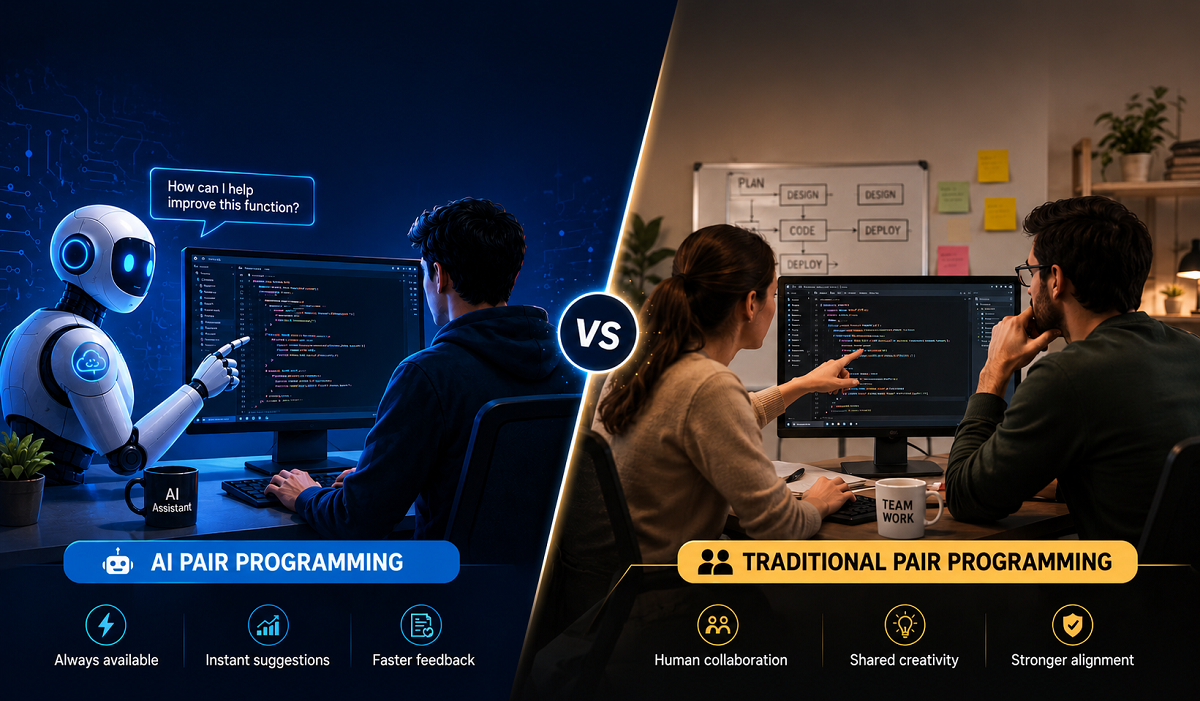
Artificial Intelligence is transforming how software teams collaborate, code, and deliver products. One of the most significant shifts in modern software development is the rise of AI pair programming a workflow where developers collaborate with AI-powered coding assistants instead of relying solely on human pairing.
For years, traditional pair programming has been a cornerstone of agile engineering teams, helping developers improve code quality, share knowledge, and reduce defects. But now, AI tools like GitHub Copilot, ChatGPT, and Codeium are changing the equation.
So, which approach is better for modern development teams? In this article, we’ll compare AI pair programming and traditional pair programming, explore their strengths and limitations, and help businesses understand how to leverage both for faster, smarter software delivery.
What Is Traditional Pair Programming?
Traditional pair programming is a collaborative software development practice where two developers work together on the same task.
Typically, one developer acts as the driver, actively writing the code, while the other acts as the navigator, reviewing logic, identifying potential issues, and thinking strategically about architecture and implementation.
The two developers switch roles regularly throughout the session.
Benefits of Traditional Pair Programming
1. Better Code Quality
Two developers reviewing code in real time often result in cleaner architecture, fewer bugs, and improved maintainability.
2. Stronger Knowledge Sharing
Pair programming encourages mentoring, onboarding, and skill transfer across the team.
3. Improved Collaboration
It strengthens communication and aligns developers around coding standards and project goals.
4. Faster Problem Solving
Complex technical issues are often solved faster when two minds collaborate.
Challenges of Traditional Pair Programming
While highly effective, traditional pair programming also comes with challenges:
- Requires two developers for one task
- Can increase development costs
- Scheduling and time-zone coordination can be difficult
- Productivity may vary depending on team dynamics
- Continuous pairing can sometimes lead to fatigue
As development cycles become faster and teams become more distributed, companies are increasingly exploring AI-driven alternatives.
What Is AI Pair Programming?
AI pair programming refers to developers collaborating with AI-powered coding assistants that provide:
- Real-time code suggestions
- Autocomplete functionality
- Bug detection
- Refactoring recommendations
- Documentation assistance
- Test case generation
- Natural language-to-code conversion
Instead of pairing with another developer, engineers interact with AI tools that act like intelligent coding companions.
Popular AI pair programming tools include:
- GitHub Copilot
- ChatGPT
- Amazon CodeWhisperer
- Codeium
- Tabnine
AI pair programming does not replace developers it enhances productivity by automating repetitive tasks and accelerating coding workflows.
AI Pair Programming vs Traditional Pair Programming
| Feature | Traditional Pair Programming | AI Pair Programming |
| Collaboration Type | Human-to-human | Human-to-AI |
| Knowledge Sharing | High | Limited contextual understanding |
| Speed | Moderate | Very fast |
| Cost Efficiency | Requires two developers | Lower operational cost |
| Creativity | Strong brainstorming capabilities | Pattern-based recommendations |
| Availability | Depends on schedules | Available 24/7 |
| Learning Curve | Great for mentorship | Helpful for self-learning |
| Bug Detection | Strong human reasoning | Fast automated suggestions |
| Scalability | Limited by team size | Highly scalable |
| Context Awareness | Deep project understanding | Depends on prompts and context |
Where AI Pair Programming Excels
AI pair programming is especially powerful for repetitive, time-consuming, and structured development tasks.
1. Faster Development Cycles
AI coding assistants can generate boilerplate code, APIs, database queries, and frontend components in seconds.
This significantly reduces development time and improves sprint velocity.
2. Increased Developer Productivity
Developers spend less time on repetitive coding tasks and more time solving business problems.
3. Real-Time Assistance
AI tools provide instant suggestions, reducing context switching and helping developers stay in flow.
4. Faster Onboarding
Junior developers can use AI assistance to understand unfamiliar frameworks, syntax, and coding patterns.
5. Continuous Availability
Unlike human pair programmers, AI tools are available anytime, making them ideal for remote and distributed teams.
Where Traditional Pair Programming Still Wins
Despite rapid AI advancements, traditional pair programming continues to offer advantages that AI cannot fully replicate.
1. Strategic Thinking
Human developers understand business goals, user needs, and architectural trade-offs more effectively than AI.
2. Mentorship and Team Growth
Traditional pairing builds communication skills, leadership, and collaborative problem-solving abilities.
3. Better Decision-Making
Experienced developers can evaluate edge cases, scalability concerns, and long-term maintainability beyond what AI models predict.
4. Stronger Team Culture
Human collaboration builds trust, accountability, and alignment across engineering teams.
The Future Is Hybrid: AI + Human Collaboration
The future of software engineering is not about replacing traditional pair programming with AI.
Instead, successful teams are adopting a hybrid development model where:
- AI handles repetitive and routine coding tasks
- Developers focus on architecture, innovation, and business logic
- Human collaboration drives strategic thinking and quality assurance
This balanced approach combines the speed of AI with the creativity and critical thinking of experienced engineers.
Modern software teams are increasingly using AI as a productivity multiplier rather than a replacement for developers.
Best Practices for AI Pair Programming
To maximise the benefits of AI pair programming, businesses should follow a structured implementation strategy.
1. Use AI as an Assistant, Not a Replacement
AI-generated code should always be reviewed and validated by experienced developers.
2. Prioritise Security and Compliance
Organisations must ensure AI-generated code aligns with security standards, privacy requirements, and coding policies.
3. Maintain Human Code Reviews
Human oversight remains essential for architecture decisions, scalability, and business alignment.
4. Train Teams on Effective Prompting
The quality of AI outputs often depends on how developers interact with the tool.
5. Combine AI with Agile Workflows
AI tools work best when integrated into collaborative agile and DevOps practices.
How Businesses Benefit from AI Pair Programming
Businesses adopting AI-assisted development often experience:
- Faster product releases
- Reduced development costs
- Improved developer efficiency
- Better scalability
- Shorter debugging cycles
- Enhanced innovation capacity
For startups and enterprises alike, AI pair programming can accelerate digital transformation initiatives while helping engineering teams maintain competitive speed.
Is AI Pair Programming Replacing Developers?
No. AI is not replacing software developers it is changing how developers work.
While AI excels at generating code patterns and automating repetitive tasks, it still lacks:
- Human intuition
- Domain expertise
- Strategic reasoning
- Product thinking
- Emotional intelligence
- Real-world business understanding
The most successful development teams will be those that learn how to combine human expertise with AI-powered efficiency.
Why Forward-Thinking Companies Are Investing in AI-Driven Development
Organisations across industries are embracing AI-enhanced software development to improve speed, innovation, and operational efficiency.
Companies that integrate AI responsibly into their engineering workflows can:
- Reduce time-to-market
- Increase developer satisfaction
- Improve software quality
- Scale engineering teams more effectively
- Stay competitive in rapidly evolving markets
As AI capabilities continue to evolve, businesses that adopt intelligent development workflows early will gain a significant competitive advantage.
Conclusion
Both AI pair programming and traditional pair programming bring valuable strengths to modern software development.
Traditional pair programming remains essential for mentorship, collaboration, strategic thinking, and architectural decision-making. Meanwhile, AI pair programming dramatically improves speed, productivity, and automation.
Rather than choosing one over the other, modern engineering teams should embrace a hybrid approach that combines human intelligence with AI-powered development tools.
At Monarch Innovation, we help businesses leverage AI, cloud technologies, and modern engineering practices to build scalable digital solutions faster and smarter.
Whether you’re exploring AI-assisted development, custom software engineering, or enterprise digital transformation, our experts can help you create future-ready technology solutions.