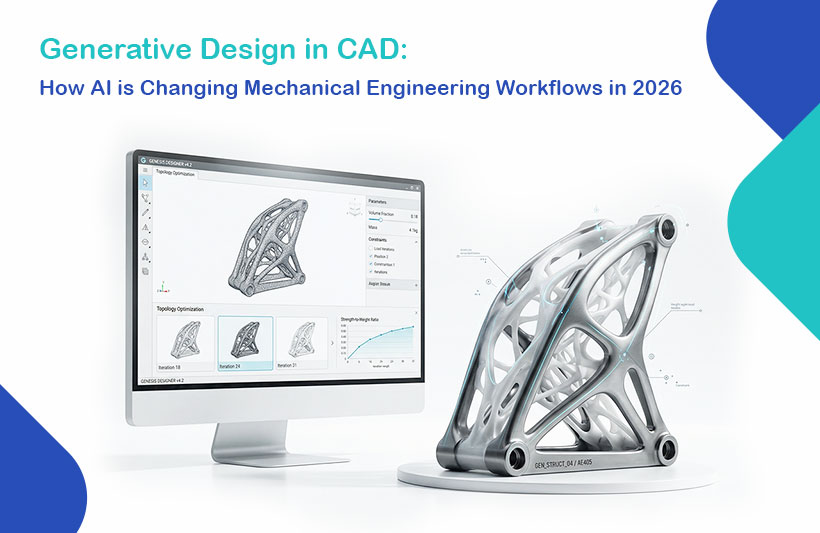
Traditional CAD workflows have long relied on manual modelling, repeated iterations, and engineer intuition. While effective, this approach is time-consuming and often limits innovation due to practical constraints. In 2026, AI-powered generative design is transforming this process, enabling engineers to explore thousands of optimised design possibilities in a fraction of the time.
AI-powered generative design tools like Autodesk Inventor, Fusion 360, and SolidWorks can automatically generate optimised CAD designs based on engineer-defined constraints. The software produces multiple design options that meet weight, strength, and manufacturing requirements, dramatically reducing manual iteration time.
Can AI generate mechanical CAD designs automatically?
Yes, AI can automatically generate mechanical CAD designs using generative design technology. Engineers input constraints such as loads, materials, manufacturing methods, and performance goals, and the AI creates multiple optimized design options that meet those requirements.
These generative design CAD systems use algorithms and simulation to evaluate each design for strength, weight, and manufacturability, reducing manual effort and speeding up the design process. However, engineers still review and finalise the best solution to ensure real-world performance and safety.
What is Generative Design in CAD?
Generative design in CAD is an AI-driven approach where software algorithms automatically create multiple design options based on specific constraints and goals defined by the engineer.
Instead of manually drawing a component, engineers input parameters such as:
- Load conditions
- Material types
- Manufacturing methods
- Cost constraints
- Performance requirements
The system then uses AI, topology optimisation, and simulation to produce a wide range of optimised designs.
Key Difference from Traditional CAD
- Traditional CAD → One design at a time
- Generative Design → Hundreds of optimised options simultaneously
This allows engineers to discover non-intuitive, high-performance geometries that would be impossible to create manually.
How Generative Design Works – Step by Step
Understanding the workflow helps clarify how AI integrates into mechanical engineering design processes.
1. Define Design Inputs
Engineers start by specifying:
- Geometry boundaries (design space)
- Load cases and forces
- Constraints (fixed areas, symmetry, etc.)
- Materials and manufacturing methods (e.g., CNC, additive manufacturing)
2. Apply Algorithms
The software runs AI-driven algorithms combined with Finite Element Analysis (FEA) to simulate performance under real-world conditions.
3. Generate Design Options
Instead of one model, the system produces:
- Dozens to hundreds of design variations
- Designs optimised for weight, strength, cost, or durability
4. Evaluate and Select
Engineers review results using performance metrics such as:
- Stress distribution
- Factor of safety
- Material usage
- Manufacturability
5. Refine and Finalise
The selected design is then:
- Converted into a production-ready CAD model
- Integrated into the broader product development cycle
Result: Massive reduction in manual iterations and faster decision-making
Key Benefits for Mechanical Engineering Teams
Generative design is not just a trend it delivers measurable engineering advantages.
1. Faster Iteration Cycles
Traditional design loops can take weeks. With AI-assisted engineering:
- Multiple concepts are generated within hours
- Design validation is integrated into the process
2. Material Optimisation
AI algorithms optimise geometry for:
- Minimum material usage
- Maximum structural efficiency
Example: Airbus used generative design to redesign a cabin bracket, reducing weight by 45% while maintaining structural integrity.
3. Enhanced Innovation
AI removes human bias, enabling:
- Organic geometries
- Lattice structures
- High strength-to-weight designs
4. Improved Product Performance
With integrated simulation tools:
- Early validation using simulation
- Reduced failure risk
- Optimised performance before prototyping
5. Reduced Development Costs
- Fewer physical prototypes
- Lower material waste
- Faster time-to-market
Top Generative Design CAD Tools in 2026
Several leading CAD platforms now integrate AI generative capabilities.
Autodesk Inventor
- Strong in parametric and mechanical design
- Integrated generative design workflows
- Ideal for industrial machinery and manufacturing
Fusion 360
- Cloud-based CAD/CAM/CAE (Computer-Aided Engineering) platform
- Built-in generative design tools
- Popular among startups and product design teams
SolidWorks Simulation
- Widely used in mechanical engineering
- Industry-standard CAD tool
- Supports topology optimization
- Strong ecosystem
nTopology
- Advanced design platform for complex geometries
- Focuses on lattice structures and additive manufacturing
- Used in aerospace and high-performance engineering
Each of these tools supports AI-driven product design, but their effectiveness depends on how well they are integrated into your workflow.
Real-World Applications of Generative Design
Aerospace
- Lightweight components improve fuel efficiency
- Optimised structural parts
- Example: Structural brackets and engine components
Automotive
- Reduced vehicle weight
- Improved EV battery performance
- Enhanced crash structures
Industrial Machinery
- Improved durability with less material
- Custom load-specific designs
Medical Devices
- Patient-specific implants
- Optimised shapes for biological compatibility
Consumer Products
- Faster product development cycles
- Innovative product aesthetics and functionality
Generative Design vs Traditional CAD Design
| Factor | Traditional CAD | Generative Design (AI) |
| Design generation | Manual, one concept at a time | Automated, 100s of options generated |
| Iteration speed | Slow | Fast |
| Material optimization | Engineer-dependent | Algorithm-optimized |
| Innovation ceiling | Limited by human assumptions | AI-driven |
| Skill requirement | Expert CAD modeler | Expert + AI tool knowledge |
How Monarch Innovation Applies AI-Driven Design
Monarch Innovation integrates generative design and CAD automation into real-world engineering workflows through its Mechanical Engineering, Design Automation, and CAD Customisation services.
As an Autodesk-aligned partner, Monarch leverages tools like Inventor and Fusion 360 to implement:
- AI-assisted design workflows
- Parametric automation for repetitive tasks
- Advanced simulation and design optimisation
Their approach focuses on practical outcomes, reducing design cycle time, improving product performance, and ensuring manufacturability. By combining engineering expertise with AI tools, Monarch Innovation helps clients transition from traditional CAD processes to intelligent, scalable design systems.
Generative Design vs CAD Automation
Generative Design
- AI generates multiple design options
- Focus on optimisation and innovation
CAD Automation
- Automates repetitive tasks
- Uses scripts and rules
Combined Power
- Generative design → Exploration
- CAD automation → Execution
Together, they create a fully intelligent engineering workflow
Challenges of Generative Design
Learning Curve
- Requires understanding of AI tools
- Knowledge of simulation is essential
Manufacturing Constraints
- Some designs are difficult to produce
- Often require additive manufacturing
Computational Resources
- High processing requirements
- Often relies on cloud computing
Validation Requirements
- Engineers must verify AI outputs
- Compliance and safety standards remain critical
How AI is Reshaping Mechanical Engineering Workflows
By 2026, generative design CAD AI systems will become standard across industries.
Key Trends
- Integration with PLM systems
- Real-time AI design feedback
- Adoption of digital twins
- Increased use by SMEs
Role of Engineers is Evolving
Engineers now focus on:
- Defining constraints
- Evaluating outputs
- Making strategic decisions
Rather than repetitive modeling tasks.
Conclusion
Generative design in CAD is redefining how mechanical engineering teams approach product development. By combining AI, simulation, and optimisation, engineers can now explore more design possibilities, reduce development time, and create higher-performing products.
For organisations looking to stay competitive, adopting AI-driven design is no longer optional, it’s a strategic advantage.
If you’re ready to modernise your engineering workflow, explore Mechanical Engineering and Design Automation services to see how intelligent CAD solutions can transform your product development process.
FAQs
What is generative design in CAD?
Generative design is an AI-driven process that automatically creates optimized design solutions based on constraints and requirements.
How does AI improve mechanical engineering design?
AI accelerates design iterations, improves optimization, and enables innovative geometries that are difficult to achieve manually.
Which software supports generative design?
Popular tools include Autodesk Inventor, Fusion 360, SolidWorks, and nTopology.
Is generative design expensive?
While initial implementation may require investment, it significantly reduces long-term development costs.