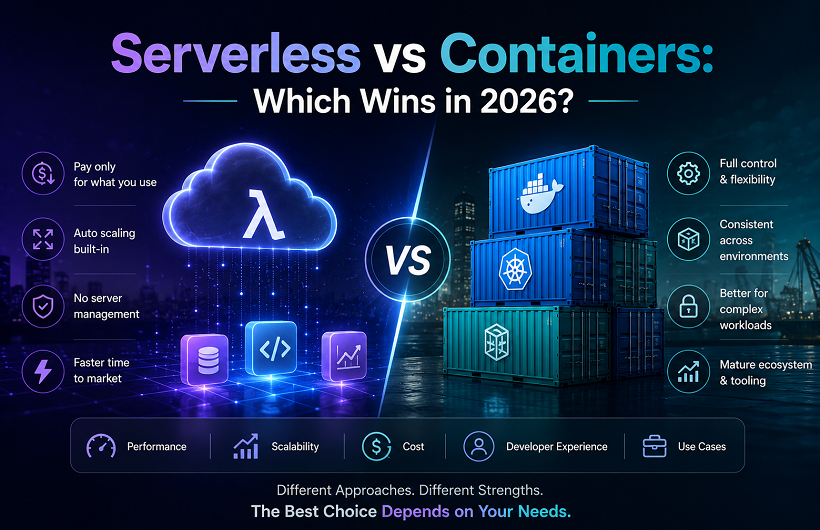
If you are building cloud applications in 2026, you have probably asked this question: should we go serverless or use containers?
The honest answer? Most engineering teams no longer choose one over the other. They use both. But understanding when to use which, and why, is what separates smart architecture decisions from expensive ones.
This guide cuts through the noise and gives you a clear, practical comparison so you can make the right call for your workload, team, and budget.
What Is Serverless Computing?
Serverless computing lets you run code without managing servers. You write a function, deploy it, and the cloud provider handles provisioning, scaling, patching, and availability automatically.
You only pay for the compute time your function actually uses. When no requests come in, you pay nothing.
How Serverless Works
Serverless follows the Functions as a Service (FaaS) model. You deploy individual functions that run in response to events, such as an HTTP request, a file upload, a queue message, or a scheduled trigger.
Major platforms include:
- AWS Lambda (most mature ecosystem)
- Azure Functions (strong Microsoft stack integration)
- Google Cloud Functions (tight GCP integration)
- Cloudflare Workers (ultra-low latency edge execution)
The provider manages everything below your code. No Dockerfiles. No cluster configuration. No OS patches.
When Serverless Makes Sense
Serverless is the right call when:
- Your workload is event-driven and sporadic
- You want to ship fast with minimal DevOps overhead
- Traffic is unpredictable and you need instant auto-scaling
- You are running background jobs, webhooks, or scheduled tasks
- Your team is small and infrastructure management is a distraction
What Are Containers?
A container packages your application code, runtime, libraries, and configuration into a single portable unit. It runs consistently across any environment, from your laptop to AWS to Azure.
Containers do not abstract the infrastructure away entirely. You still decide how many instances to run, how to scale them, and where to deploy them. That control is the point.
How Containers Work
Most container workflows today use:
- Docker for building and packaging container images
- Kubernetes (K8s) for orchestrating and scaling containers across clusters
- AWS ECS / Fargate for managed container hosting on AWS
- Azure Kubernetes Service (AKS) and Google Kubernetes Engine (GKE) for cloud-native K8s
Containers run as long-lived processes. Unlike serverless functions that spin up per request, containers stay running and handle multiple requests continuously.
When Containers Make Sense
Containers are the right call when:
- Your application runs continuously with steady traffic
- You need fine-grained control over the runtime environment
- You are running stateful workloads, databases, or AI/ML inference
- Your team has DevOps maturity and Kubernetes experience
- You need to avoid vendor lock-in with portable, cloud-agnostic deployments
Serverless vs Containers
| Feature | Serverless | Containers |
| Deployment Model | Event-driven, ephemeral functions | Long-running processes or microservices |
| Cold Starts | 50ms to 800ms depending on runtime | Near-zero (container already warm) |
| Cost Model | Pay per invocation and execution time | Pay per hour, regardless of traffic |
| Scalability | Automatic, instant, near-infinite | Kubernetes or ECS-based, configurable |
| Operational Overhead | Very low (provider manages infra) | Medium to high (cluster management required) |
| Control Over Environment | Low | High |
| Vendor Lock-in Risk | Higher (platform-specific triggers and APIs) | Lower (Docker images are portable) |
| Best For | Sporadic, event-driven workloads | Steady, stateful, or latency-sensitive workloads |
| AI/ML Workloads | Limited (no native GPU support on most FaaS) | Strong (GPU-enabled containers on K8s) |
| Local Development | Harder to replicate locally | Easy with Docker Desktop |
Cost Breakdown: Serverless vs Containers in Real Workloads
Cost is where most teams get surprised. Serverless is not always cheaper, and containers are not always more expensive. It depends entirely on your traffic pattern.
When Serverless Is Cheaper
Serverless wins on cost when your application has sporadic or unpredictable traffic.
For workloads under 50,000 invocations per day or those with a duty cycle below 10%, serverless can save 60 to 80% compared to running dedicated containers. You pay only when the code runs. Idle time costs nothing.
Typical use cases where serverless saves money: image processing pipelines, nightly data exports, webhook receivers, notification triggers, and internal automation jobs.
When Containers Save More Money
Containers become cheaper when your application runs continuously at steady traffic levels.
A real example from the industry: an API handling around 400 requests per second on AWS Lambda with API Gateway was costing a team over $14,000 per month. The same workload on two Fargate tasks behind a load balancer would have cost around $180 per month. The difference? Lambda’s per-invocation billing becomes brutal at sustained load.
The tipping point is roughly when your workload crosses 50% duty cycle. Beyond that, paying by the hour (containers) almost always beats paying by the invocation (serverless).
Hybrid FinOps teams that place workloads on the right model report 30 to 48% cost reductions overall.
Cold Starts and Latency: What Has Changed in 2026?
Cold starts have been the biggest complaint about serverless for years. In 2026, the situation has improved but not disappeared.
Current cold start averages on AWS Lambda:
Cloud providers have made progress here. AWS Lambda SnapStart for Java, provisioned concurrency, and Cloudflare Workers’ V8 isolate model have all reduced cold start pain for common runtimes.
But for applications where every millisecond matters, such as real-time APIs, financial transactions, or interactive user experiences, containers remain the better choice. A warm container has near-zero startup latency.
If you are on serverless and cold starts are hurting you, options include provisioned concurrency (adds cost), switching to a faster runtime, or moving that specific service to containers.
Scalability: Which One Scales Better?
Both scale well. The difference is how they scale and what that means for your operations.
Serverless scales automatically, instantly, and without any configuration. AWS Lambda can go from zero to thousands of concurrent executions in seconds. You do not set a maximum (though account limits apply). This is ideal for unpredictable traffic spikes.
Containers scale through Kubernetes Horizontal Pod Autoscaler (HPA) or ECS service auto-scaling. You configure the rules, thresholds, and limits. Scale-up takes 30 seconds to a couple of minutes, depending on your setup. For most steady-traffic applications, this is more than fast enough.
The real scaling advantage of serverless is that it requires zero operational effort. The advantage of containers is that you get predictable, controlled scaling with no surprise bills.
Serverless vs Containers for AI and ML Workloads
This is one of the clearest differences in 2026.
AI and ML workloads favour containers, almost universally.
Here is why:
- Most FaaS platforms do not support GPU instances natively
- ML model loading times are too slow for per-invocation cold starts
- Training jobs are long-running, not event-driven
- Inference at scale benefits from warm, persistent model-in-memory containers
- Kubernetes GPU node pools give fine-grained resource control for inference serving
If you are building AI-powered applications, RAG pipelines, or running inference at scale, containers on GPU-enabled Kubernetes clusters are the standard choice in 2026.
Serverless can still play a role at the edges: triggering inference jobs, handling incoming requests, pre-processing data before sending it to a container-based inference service. But the heavy lifting happens in containers.
The Hybrid Architecture: Why Most Teams Use Both in 2026
Here is the truth that most comparison articles avoid: the serverless vs containers debate is mostly settled in production environments.
Over 78% of engineering teams now run hybrid architectures, combining both models deliberately to optimise cost, speed, and control.
A typical hybrid setup might look like this:
- Serverless functions handle webhooks, file processing triggers, scheduled jobs, and notification pipelines
- Containers on Kubernetes serve the core API, handle AI inference, run stateful services, and manage long-running background workers
- Serverless containers (Google Cloud Run, AWS Fargate) bridge the gap, offering container portability with serverless-style scaling and billing
The line between the two models is also blurring at the platform level. Google Cloud Run already supports scale-to-zero, event triggers, and no-HTTP jobs. AWS Fargate now has per-second billing and EventBridge integration. You can deploy a container image and get near-serverless operational experience.
Delivering a hybrid cloud architecture well also depends on having the right deployment pipeline in place. If your team is still setting up CI/CD pipelines, that is the foundation that makes hybrid cloud manageable at any team size.
How to Choose Between Serverless and Containers in 2026
Choose Serverless If:
- Your workload is event-driven, sporadic, or batch-oriented
- You want zero infrastructure management
- Traffic is unpredictable with large peaks and quiet periods
- You are a small team or startup that needs to ship fast
- Cost optimization for low-traffic workloads is a priority
Choose Containers If:
- Your application runs continuously with steady traffic
- You need GPU support for AI or ML workloads
- You require full control over the runtime environment
- You have DevOps capacity to manage Kubernetes or ECS
- Portability and avoiding vendor lock-in matter to your architecture
Choose Hybrid If:
- You have both event-driven and long-running workloads
- You want to optimize costs across different traffic patterns
- Your team has the maturity to manage multiple compute models
- You are building a microservices or AI-integrated architecture
- You need scalability without sacrificing control
Most engineering teams at scale land here. If you want expert support designing or migrating to a hybrid cloud setup, Monarch Innovation’s cloud engineering services cover architecture, containerization, and DevOps automation end to end.
Ready to Build the Right Cloud Architecture?
At Monarch Innovation, our cloud and DevOps engineers help engineering teams design cloud-native architectures that balance cost, performance, and scalability. Whether you are evaluating serverless, Kubernetes, or a hybrid cloud strategy, we bring the technical depth and delivery experience to get it right.
Talk to Our Cloud Architects and get a free architecture review for your application.
Monarch Innovation is a global engineering, software development, cloud, and digital transformation company serving startups, enterprises, and industrial businesses worldwide.