
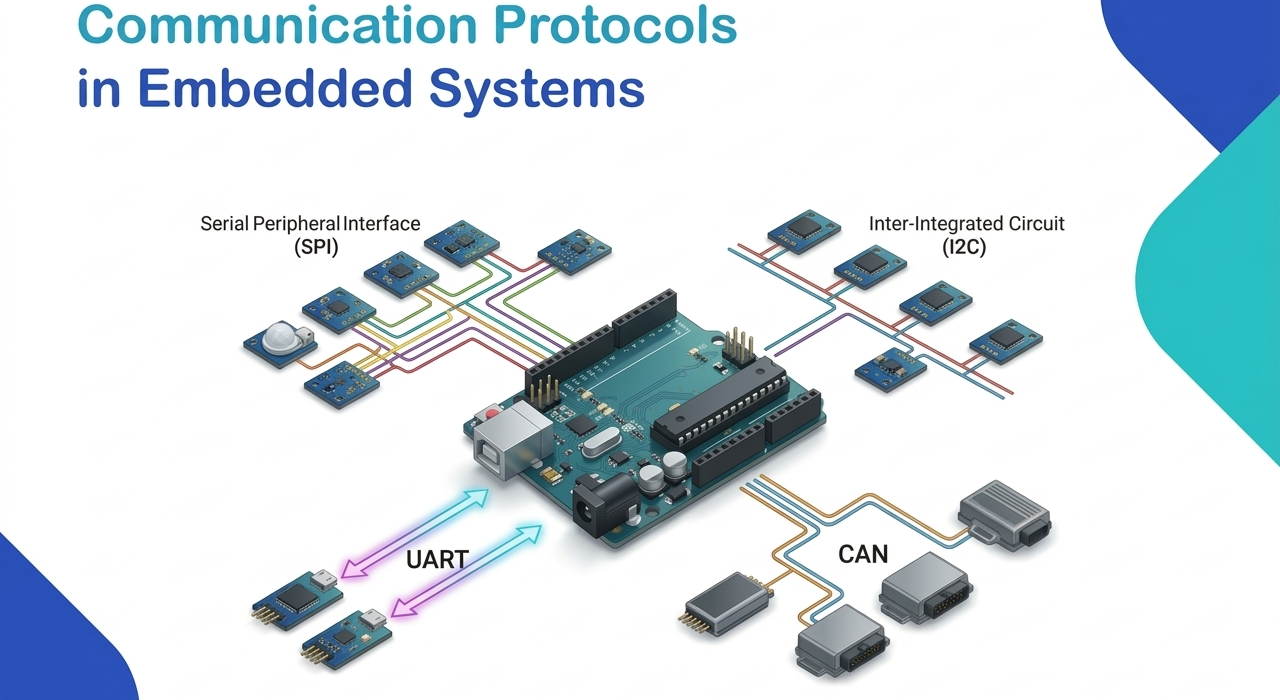
Communication protocols in embedded systems are essential for enabling devices to exchange data efficiently and reliably. From simple microcontroller communication to complex industrial automation, these protocols define how data is transmitted, received, and processed.
In this guide, we’ll explore the types of communication protocols in embedded systems, their differences, real-world applications, and how emerging technologies like 5G, IoT, and LoRaWAN are shaping the future.
What are Communication Protocols in Embedded Systems?
Communication protocols are predefined rules that determine how data is transmitted between components in an embedded system. These protocols ensure that devices can communicate without errors, delays, or data loss.
They are crucial for:
- Real-time data processing
- Device synchronization
- Reliable system performance
- Low power consumption
Types of Communication Protocols in Embedded Systems
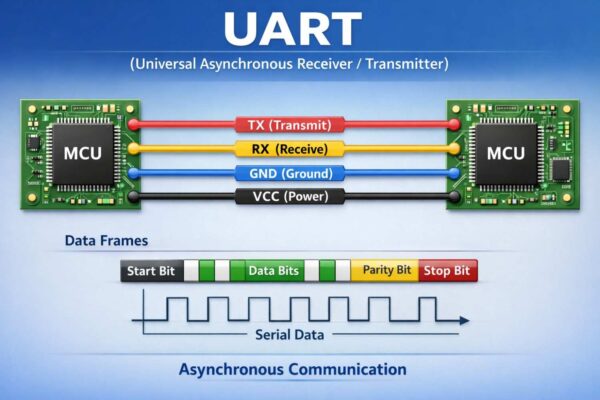
1. UART (Universal Asynchronous Receiver/Transmitter)
UART (Universal Asynchronous Receiver/Transmitter) is one of the most widely used communication protocols in embedded systems for serial data transmission between devices. It enables communication without requiring a shared clock signal, making it simple and efficient for short-distance communication.
Key Features:
- Asynchronous communication (no clock signal required)
- Full-duplex communication (simultaneous transmit and receive)
- Simple hardware implementation
- Configurable baud rate
Use Cases:
- Debugging and console communication
- GPS modules
- Bluetooth modules
- Microcontroller-to-microcontroller communication
2. SPI (Serial Peripheral Interface)
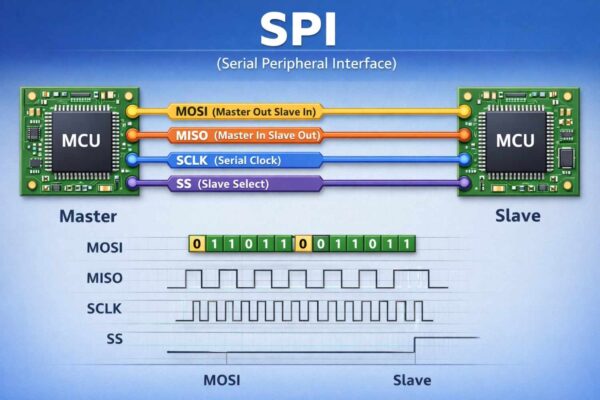
SPI (Serial Peripheral Interface) is a high-speed synchronous communication protocol widely used in embedded systems for short-distance communication between microcontrollers and peripheral devices. It uses a master-slave architecture and a shared clock signal to enable fast and reliable data transfer.
Key Features:
- Synchronous communication (uses a clock signal)
- Full-duplex communication (simultaneous data transmission and reception)
- High data transfer speed (faster than I2C and UART)
- Master-slave architecture with multiple slave support
- Uses four lines: MOSI, MISO, SCLK, and SS
Use Cases:
- Sensors and ADCs
- SD cards and flash memory
- LCD and OLED displays
- Real-time data streaming applications
3. I2C (Inter-Integrated Circuit)
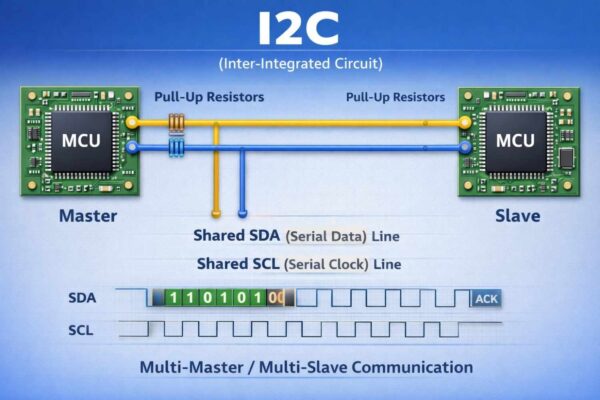
I2C (Inter-Integrated Circuit) is a synchronous communication protocol widely used in embedded systems to connect multiple devices using just two wires. It allows multiple master and slave devices to communicate efficiently using an address-based system.
Key Features:
- Synchronous communication (uses a clock signal)
- Multi-master and multi-slave support
- Uses only two wires: SDA (data) and SCL (clock)
- Address-based communication (each device has a unique address)
- Supports multiple devices on the same bus
Use Cases:
- EEPROM and memory devices
- Real-Time Clock (RTC) modules
- Sensors (temperature, humidity, etc.)
- Low-speed peripheral communication
4. CAN (Controller Area Network)
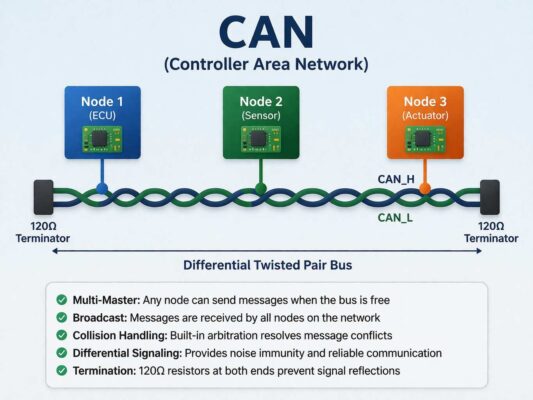
CAN (Controller Area Network) is a robust, message-based communication protocol widely used in embedded systems, especially in automotive and industrial applications. It enables multiple microcontrollers to communicate with each other without the need for a central computer, making it highly reliable for real-time systems.
Key Features:
- Multi-master communication (no central controller required)
- High reliability with built-in error detection and fault confinement
- Message-based protocol (no device addressing like I2C)
- Real-time communication with priority-based message arbitration
- Suitable for noisy environments
Use Cases:
- Automotive systems (ECUs, sensors, airbags)
- Industrial automation and control systems
- Robotics and manufacturing systems
5. Ethernet
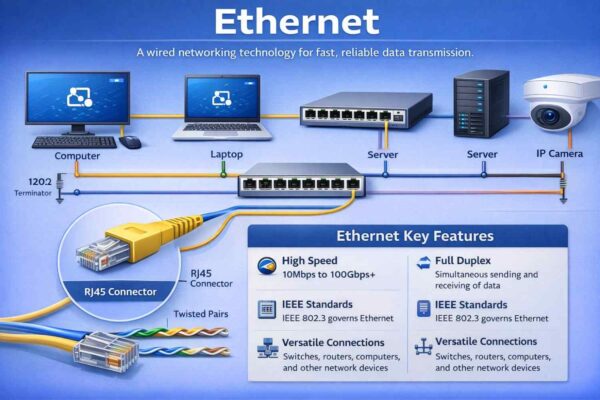
Ethernet is a high-speed wired communication protocol used in embedded systems that require reliable network connectivity and large data transfer. It enables devices to communicate over local area networks (LAN) and the internet, making it ideal for industrial and connected applications.
Key Features:
- High data transfer rates (up to Gbps speeds)
- Reliable and stable wired communication
- Scalable for large network systems
- Supports TCP/IP for internet connectivity
- Low latency for real-time applications
Use Cases:
- Industrial IoT (IIoT) systems
- Smart factories and automation
- Network-enabled embedded devices
- Data acquisition and monitoring systems
6. Wireless Communication Protocols (Wi-Fi, Bluetooth, Zigbee)
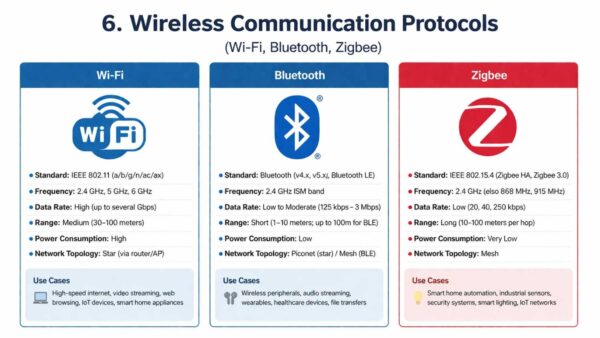
Wireless communication protocols in embedded systems enable devices to communicate without physical connections, making them essential for modern applications like IoT, smart homes, and wearable technology. These protocols provide flexibility, scalability, and remote connectivity across a wide range of devices.
Key Features:
- Wireless communication (no cables required)
- Flexible and easy deployment
- Supports remote and real-time communication
- Scalable for large networks of connected devices
- Varying range and power consumption depending on protocol
Common Types:
- Wi-Fi – High-speed communication with internet connectivity
- Bluetooth – Short-range, low-power communication for personal devices
- Zigbee – Low-power, mesh networking for IoT applications
Use Cases:
- Smart home automation systems
- Wearable and healthcare devices
- IoT and smart city applications
- Wireless sensor networks
Comparison of Communication Protocols in Embedded Systems
| Protocol | Type | Speed | Complexity | Distance | Power Consumption | Common Use Cases |
|---|---|---|---|---|---|---|
| UART | Wired | Low (~1 Mbps) | Low | Short | Low | Debugging, GPS, Bluetooth modules |
| SPI | Wired | High (10+ Mbps) | Medium | Short | Medium | Sensors, displays, SD cards |
| I2C | Wired | Medium (100 kbps–3.4 Mbps) | Low | Short | Low | EEPROM, RTC, multiple peripherals |
| CAN | Wired | Medium (1 Mbps) | High | Medium | Medium | Automotive, industrial control |
| Ethernet | Wired | Very High (100 Mbps–1 Gbps+) | High | Long | High | Industrial IoT, networking |
| Wireless | Wireless | Varies | Medium | Medium–Long | Low–Medium | IoT, smart homes, wearables |
Wired vs Wireless Communication Protocols in Embedded Systems
Communication protocols in embedded systems can be broadly classified into wired and wireless protocols, each offering unique advantages depending on application requirements.
Wired Protocols
Wired communication protocols use physical connections such as cables to transmit data between devices.
Advantages:
- More reliable and stable communication
- Faster and consistent data transfer rates
- Lower interference and noise
- Better security compared to wireless
Examples: UART, SPI, I2C, CAN, Ethernet
Wireless Protocols
Wireless communication protocols enable data transmission without physical connections, making them ideal for modern and distributed systems.
Advantages:
- Flexible and easy to deploy
- Scalable for large networks
- Supports remote communication
- Reduces wiring complexity
Examples: Wi-Fi, Bluetooth, Zigbee
Key Difference
Wired protocols offer higher reliability and speed, while wireless protocols provide greater flexibility and scalability, making both essential in modern embedded systems.
Emerging Communication Technologies in Embedded Systems
Modern embedded systems are evolving with advanced communication technologies:
5G Technology
5G is transforming communication in embedded systems by providing ultra-high-speed data transfer and extremely low latency. With speeds up to gigabits per second and latency as low as milliseconds, 5G enables real-time applications such as autonomous vehicles, remote healthcare, and industrial automation.
Internet of Things (IoT)
The Internet of Things (IoT) allows embedded systems to connect, communicate, and exchange data over the internet. This enables smart automation, remote monitoring, and predictive maintenance in applications like smart homes, industrial IoT, and connected devices.
LoRaWAN
LoRaWAN (Long Range Wide Area Network) is a low-power, long-range communication protocol designed for large-scale IoT deployments. It is ideal for applications such as smart agriculture, environmental monitoring, and smart city infrastructure, where devices need to operate over long distances with minimal power consumption.
These emerging technologies are not replacing traditional communication protocols like UART, SPI, and CAN, but instead complementing them to create hybrid communication models in modern embedded systems.
Future of Communication Protocols in Embedded Systems
The future of communication in embedded systems will be driven by advancements in connectivity, intelligence, and energy efficiency. As systems become more complex and interconnected, modern communication protocols will evolve to support faster, smarter, and more reliable data exchange.
Key Trends:
- Hybrid communication models combining 5G, IoT, and LoRaWAN
- AI-driven communication optimization for efficient data routing
- Enhanced security protocols to protect connected devices
- Ultra-low power communication for battery-operated systems
These advancements will drive innovation across industries such as healthcare, transportation, smart cities, and industrial automation, enabling more scalable, efficient, and intelligent embedded systems.
Conclusion
Communication protocols in embedded systems play a critical role in enabling seamless and reliable data exchange across devices. From traditional protocols like UART, SPI, and I2C to advanced technologies such as 5G, IoT, and LoRaWAN, embedded communication continues to evolve to meet modern connectivity demands.
By understanding the strengths and limitations of different communication protocols, developers can select the most suitable solution for their applications. This ensures the development of efficient, scalable, and future-ready embedded systems capable of powering next-generation technologies.
For organizations looking to implement advanced embedded communication solutions, Monarch Innovation offers expertise in developing scalable and high-performance systems tailored to modern industry needs.
FAQs
What are communication protocols in embedded systems?
They are rules that define how data is transmitted between devices in an embedded system.
Which communication protocol is the fastest?
SPI and Ethernet are among the fastest protocols used in embedded systems.
What is the difference between SPI and I2C?
SPI is faster and uses more wires, while I2C is slower but uses fewer wires and supports multiple devices.
Why are communication protocols important?
They ensure reliable, efficient, and error-free data transmission in embedded systems.