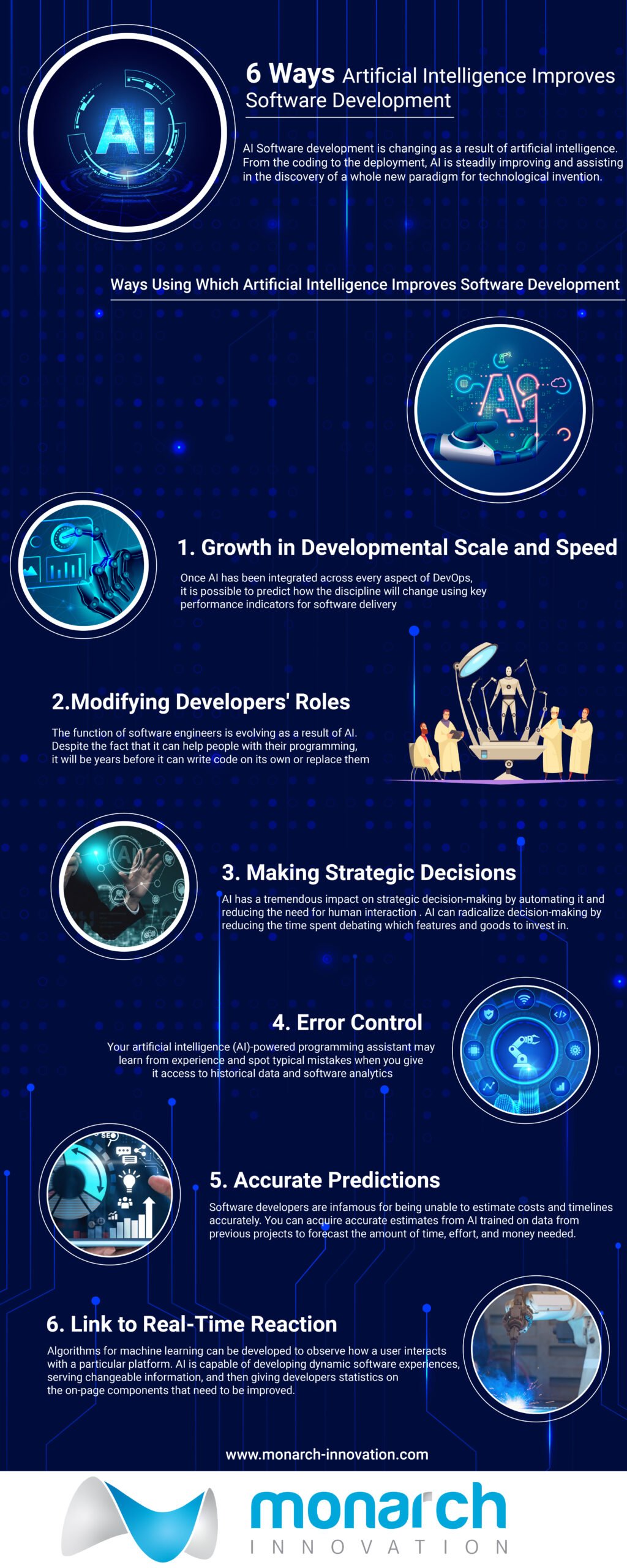
Generative AI (GenAI) has evolved from experimental technology into a practical business tool that is transforming how software is designed, developed, tested, and maintained. Organisations across industries are integrating AI-powered development workflows to accelerate delivery cycles, reduce development costs, and improve software quality.
For modern businesses, GenAI is no longer just a coding assistant. It acts as a productivity multiplier that helps engineering teams automate repetitive tasks, enhance collaboration, and focus on solving complex business challenges.
In this article, we’ll explore seven practical uses of GenAI in modern software development and how organisations can leverage it to build better software faster.
What Is Generative AI in Software Development?
Generative AI refers to artificial intelligence models capable of generating text, code, documentation, test cases, user stories, and other software-related outputs based on natural language prompts and contextual information.
Unlike traditional automation tools, GenAI can understand intent, learn patterns from large datasets, and assist developers throughout the Software Development Lifecycle (SDLC). Industry research shows that developers are increasingly using GenAI for implementation, testing, documentation, and design-related tasks to improve efficiency and reduce manual effort.
As organisations pursue faster digital transformation, GenAI is becoming an essential component of modern engineering workflows.
Why Businesses Are Investing in GenAI-Powered Development
Businesses are adopting GenAI because it helps:
- Accelerate software delivery timelines
- Improve developer productivity
- Reduce repetitive manual work
- Enhance software quality
- Support faster innovation cycles
- Optimize engineering costs
Rather than replacing developers, GenAI serves as a collaborative assistant that enables teams to spend more time on strategic problem-solving and less time on routine tasks.
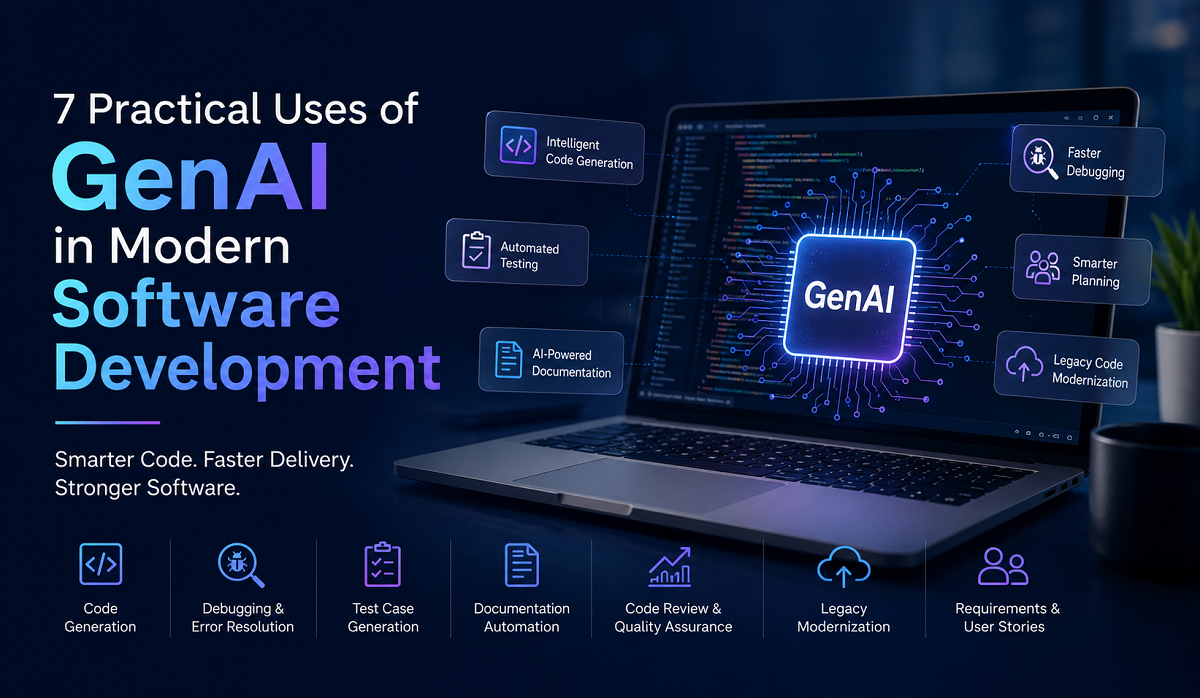
7 Ways GenAI Can Help Improve Software Development
GenAI is helping software teams work faster and more efficiently throughout the development lifecycle. From planning and coding to testing and deployment, AI-powered tools can automate repetitive tasks, improve productivity, and support developers in building high-quality software.
1. Intelligent Code Generation
One of the most widely adopted uses of GenAI is automated code generation.
Developers can describe functionality using natural language, and AI-powered tools can generate code snippets, functions, APIs, and application components in multiple programming languages.
Benefits include:
- Faster development cycles
- Reduced boilerplate coding
- Improved productivity
- Rapid prototyping
For startups and enterprises alike, AI-assisted coding helps development teams move from concept to implementation much faster while maintaining development standards. Research has shown significant reductions in repetitive coding efforts when AI coding assistants are used effectively.
2. Faster Debugging and Error Resolution
Identifying and fixing software defects often consumes a significant portion of development resources.
GenAI can help developers:
- Analyze error logs
- Detect coding issues
- Suggest fixes
- Explain root causes
- Recommend optimisation strategies
Instead of spending hours investigating common issues, developers can use AI-generated insights to troubleshoot problems more efficiently. This accelerates issue resolution and improves overall software reliability.
3. Automated Test Case Generation
Software testing is essential for delivering high-quality applications, but creating comprehensive test cases can be time-consuming.
GenAI can generate:
- Unit tests
- Integration tests
- Regression test scenarios
- Edge-case testing recommendations
- QA documentation
By automating test creation, organisations can increase test coverage while reducing manual QA effort. Recent studies indicate that GenAI significantly impacts testing workflows and can reduce the time required for test-related tasks. When combined with human oversight, AI-powered testing can improve software quality without introducing unnecessary technical debt.
4. AI-Assisted Software Documentation
Documentation is often one of the most neglected aspects of software development.
GenAI can automatically generate:
- Technical documentation
- API documentation
- Code comments
- User guides
- Knowledge base Articles
Maintaining accurate documentation becomes easier when AI continuously updates and generates content based on the latest codebase changes. This improves collaboration between developers, QA teams, project managers, and stakeholders while reducing onboarding time for new team members.
5. Requirements Analysis and User Story Creation
Business requirements are often communicated through meetings, emails, spreadsheets, and stakeholder discussions.
GenAI can transform raw business inputs into:
- User stories
- Acceptance criteria
- Product requirements
- Functional specifications
- Sprint planning documents
This helps bridge the communication gap between business teams and development teams. As a result, organisations can improve project clarity, reduce misunderstandings, and accelerate development planning.
6. Code Review and Quality Assurance
Manual code reviews are critical but can become bottlenecks in fast-moving development environments.
GenAI can support review processes by:
- Identifying coding inconsistencies
- Detecting potential vulnerabilities
- Suggesting performance improvements
- Highlighting maintainability issues
- Enforcing coding standards
AI-assisted code reviews enable engineering teams to maintain high-quality standards while increasing review efficiency.
However, organisations should implement human-in-the-loop review processes to ensure accuracy and governance. Industry experts continue to emphasise the importance of combining AI-generated recommendations with developer expertise.
7. Accelerating Legacy Application Modernisation
Many enterprises still rely on legacy systems that are expensive to maintain and difficult to scale.
GenAI can assist modernisation initiatives by:
- Analysing legacy codebases
- Recommending architecture improvements
- Refactoring outdated code
- Generating migration documentation
- Supporting cloud migration projects
This enables organisations to modernise applications more efficiently while minimising business disruption.
For enterprises undergoing digital transformation, GenAI can significantly reduce the effort required to upgrade ageing software infrastructure.
Key Considerations When Implementing GenAI
While GenAI delivers substantial benefits, successful implementation requires a strategic approach.
Organisations should consider:
Data Security and Compliance
AI systems must align with data privacy regulations and internal governance requirements.
Human Oversight
Developers should validate AI-generated outputs before deployment to ensure quality and accuracy.
Prompt Engineering Best Practices
The quality of AI outputs depends heavily on how instructions and contextual information are provided.
Integration with Existing Development Workflows
GenAI should complement existing DevOps, Agile, and CI/CD processes rather than disrupt them. A balanced approach ensures organisations gain productivity benefits while minimising risks.
The Future of GenAI in Software Development
As AI models continue to evolve, software development will become increasingly collaborative between humans and intelligent systems.
Future capabilities may include:
- Autonomous coding agents
- Advanced software architecture recommendations
- AI-driven project management
- Automated software optimization
- Continuous quality monitoring
Organisations that adopt GenAI strategically today will be better positioned to innovate faster and remain competitive in tomorrow’s digital landscape.
Conclusion
Generative AI is transforming software development by helping teams generate code, automate testing, improve documentation, accelerate debugging, enhance code quality, and modernise legacy systems.
While AI cannot replace the creativity, judgment, and expertise of skilled developers, it can significantly increase productivity and streamline software delivery processes.
Businesses that successfully integrate GenAI into their development workflows can reduce costs, accelerate innovation, and deliver better digital experiences to their customers.
Ready to Integrate GenAI into Your Software Development Process?
Whether you’re looking to build AI-powered applications, modernise legacy systems, automate development workflows, or implement intelligent software solutions, Monarch Innovation can help.
Our team of AI engineers, software architects, and digital transformation specialists develops custom GenAI solutions tailored to your business goals. Talk to our experts today to explore how GenAI can accelerate your software development initiatives and drive measurable business outcomes.
GenAI in Software Development FAQs
GenAI is commonly used for code generation, debugging, software testing, documentation creation, code reviews, requirements analysis, and legacy application modernisation. It helps development teams build and deploy software more efficiently.
No. Generative AI is designed to assist developers, not replace them. While it can automate routine tasks and provide coding suggestions, human expertise is still essential for architecture design, decision-making, security, and business problem-solving.
The key benefits include faster development cycles, improved developer productivity, reduced manual effort, better code quality, enhanced testing coverage, and lower software development costs.
AI-generated code can accelerate development, but it should always be reviewed and tested by developers before deployment. Organisations should also follow security best practices and coding standards when using AI-assisted development tools.
GenAI can automatically generate test cases, identify edge cases, create QA documentation, and support regression testing. This helps improve software quality while reducing manual testing effort.
Industries such as healthcare, fintech, eCommerce, manufacturing, logistics, education, and enterprise technology are increasingly adopting GenAI to accelerate software innovation and digital transformation.
Businesses can integrate GenAI through AI-powered development tools, custom AI solutions, and workflow automation platforms. Working with an experienced software development partner can help ensure successful implementation and measurable business outcomes.