
Harsh Joshi
Co-founder & Technical Director
Compare vacuum casting and injection molding on cost, lead time, tolerances and materials, find your cost crossover point, and avoid the design traps that slow the move to production tooling.
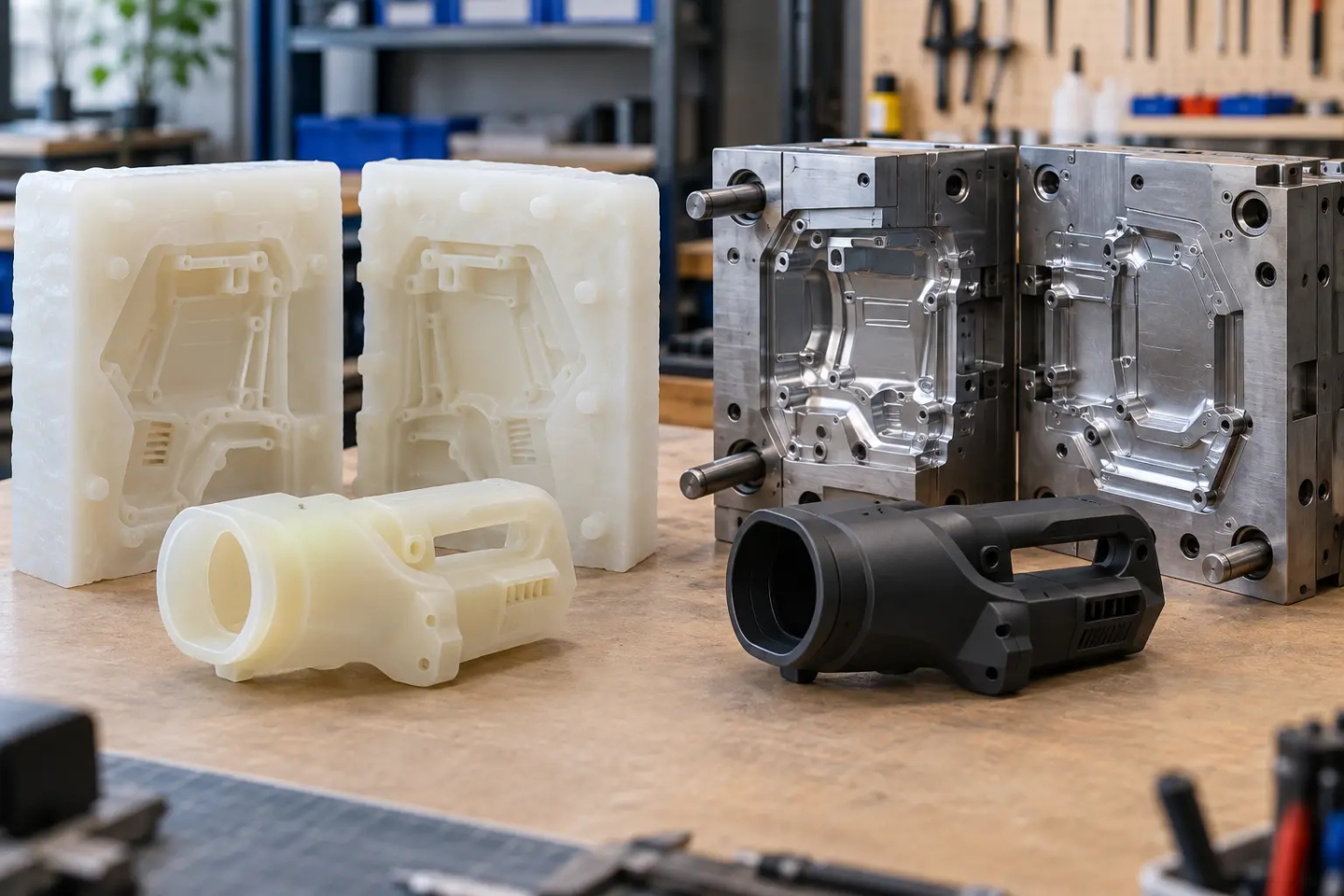
Vacuum casting vs injection molding comes down to volume, timing and how close the part needs to be to production. Vacuum casting pours polyurethane resin into a silicone mold and suits tens to a few hundred parts. Injection molding forces molten plastic into a metal tool and suits thousands to millions of parts. The first is cheaper to start. The second is cheaper per part once tooling is paid off.
The harder question is when to move from one to the other. A product team with 40 housings needed for user trials next month has a very different problem from a team about to order 20,000 units. This guide explains how each process works, where the real differences show up, how to work out your own cost crossover point, and how to avoid the design traps that catch teams during the switch. Both processes sit inside Monarch Innovation's R&D and prototyping services, so the advice here comes from choosing between them on real projects.
Quick answer
Choose vacuum casting when you need a small batch of production-like parts quickly and the design may still change. Choose injection molding when the design is frozen, volumes are high, or you need the exact production material for testing and certification.
Vacuum Casting vs Injection Molding at a Glance
| Factor | Vacuum Casting | Injection Molding |
|---|---|---|
| Mold type | Soft silicone mold made from a master pattern | Machined aluminium or hardened steel tool |
| Upfront tooling cost | Low | High |
| Cost per part | Higher, labour-intensive | Very low at volume |
| Typical volume | Tens to a few hundred parts | Thousands to millions of parts |
| Time to first parts | Days | Weeks, longer for steel tools |
| Mold life | Around 15 to 25 parts per silicone mold | Thousands to millions of shots |
| Materials | Polyurethane resins that simulate ABS, PC, PP, rubber and clear plastics | Hundreds of real thermoplastics and engineering resins |
| Tolerances | Looser, varies with geometry and resin | Tighter and highly repeatable |
| Design changes | Cheap: make a new master and mold | Costly: tool rework or a new tool |
| Best for | Prototypes, user trials, pilot runs, bridge production | Frozen designs, mass production, certified products |
What Is Vacuum Casting?
Vacuum casting is a low-volume process that makes plastic parts by pouring liquid polyurethane resin into a silicone mold inside a vacuum chamber. The vacuum pulls air out of the resin and the mold, so parts come out without bubbles and with fine surface detail.
The process starts with a master pattern, usually made by SLA or SLS 3D printing or CNC machining. Liquid silicone is poured around the master and cured. The mold is then cut open, the master removed, and the cavity left behind becomes the shape of every cast part.
Each silicone mold wears out after a limited number of castings. At Monarch Innovation, a mold typically yields around 15 to 25 quality parts, depending on geometry and resin. For larger batches, more molds are made from the same master. You can see the full workflow, materials and finishing options on our vacuum casting and prototyping page.
What Is Injection Molding?
Injection molding is a high-volume process that injects molten thermoplastic under high pressure into a precision metal tool, cools it, and ejects a finished part every few seconds to a minute. Once the tool exists, every part is almost identical.
The tool is the big investment. It is machined from aluminium or hardened steel, with cooling channels, ejector pins, gates and runners designed around the part. Aluminium tools are faster and cheaper to make but wear sooner. Steel tools take longer and cost more but can run for very long production lives.
Because the cost of the tool is spread across every part made, the cost per part drops sharply as volume grows. That is why injection molding dominates mass production. Monarch Innovation's custom injection molding services cover mold design, aluminium prototype tooling, T1 sampling and production runs.
The Differences That Actually Affect Your Decision
Most comparisons list the same pros and cons. In practice, five differences decide the outcome on real projects.
Upfront tooling cost vs cost per part
Vacuum casting has a low entry cost because a silicone mold is cheap and quick to make. However, every part is mixed, poured, cured and demolded by hand, so the price per part stays relatively high.
Injection molding flips that pattern. The tool is a large upfront cost, but each additional part costs very little. For a small batch, casting wins easily. For a large one, molding wins by a wide margin.
Lead time to the first part and the thousandth part
Vacuum cast parts can arrive within days. Monarch Innovation's standard lead time for vacuum casting is 5 to 10 business days. Injection molding takes longer to start because the tool has to be designed, machined and sampled first.
The picture changes at volume. A single silicone mold produces only a handful of parts per day because each casting has to cure. An injection molding machine can produce hundreds or thousands of parts in the same time. So casting is faster to the first part, and molding is faster to the thousandth.
Tolerances and repeatability
Injection molding holds tighter tolerances and repeats them shot after shot, which matters for snap fits, sealing faces and assemblies with many mating parts. Vacuum casting tolerances are looser and vary more, because silicone molds flex and resins shrink as they cure.
For appearance models and fit checks, vacuum casting accuracy is usually enough. For a gasket groove or a press-fit boss that must work across thousands of assemblies, it usually is not.
Materials: simulated vs real
This is the difference teams most often underestimate. Vacuum casting uses polyurethane resins that imitate production plastics such as ABS, polycarbonate, polypropylene and rubber. They look and feel close, but they are not the same material.
That matters when the part has to pass a test tied to a specific resin. Flammability ratings such as UL 94, chemical resistance checks, long-term heat exposure and biocompatibility testing for medical devices all depend on the actual production material. A cast "ABS-like" part cannot stand in for real ABS in those tests. If certification is on your roadmap, plan for molded parts in the real resin before you submit.
Part geometry and design freedom
Flexible silicone molds can release undercuts and awkward shapes that a rigid metal tool cannot. Vacuum casting also tolerates draft-free walls and uneven wall thickness better than injection molding does.
That freedom is useful early on. It also hides problems, which we cover in the design section below.
How Do You Find the Crossover Point Between Them?
The crossover point is the quantity at which the total cost of injection molding drops below the total cost of vacuum casting. Below that number, casting is cheaper. Above it, molding is cheaper. You can calculate it from two supplier quotes.
The crossover formula
Vacuum casting total = master pattern + (number of silicone molds × mold cost) + (quantity × cast part price) Injection molding total = tooling cost + (quantity × molded part price) The crossover is the quantity where both totals are equal.
To work it out for your own part:
- Get a vacuum casting quote that separates the master pattern, the cost of each silicone mold and the price per cast part.
- Get an injection molding quote that separates tooling from the price per molded part. Ask for both aluminium and steel tooling if volumes are uncertain.
- Divide your target quantity by the parts each silicone mold can produce to find how many molds you need.
- Calculate both totals at your target quantity, then at double and half that quantity.
- Compare the totals, then weigh in timing, design stability and testing needs before you decide.
The last step matters. A cheaper total is not the right answer if the design will change twice more, or if you need certified parts that only molding can provide.
The Middle Option Most Comparisons Skip: Aluminium Prototype Tooling
Vacuum casting and steel production tooling are not the only choices. Aluminium prototype tooling, sometimes called rapid tooling or bridge tooling, sits between them. It produces real injection molded parts in the production resin, at lower tooling cost and with a shorter lead time than hardened steel.
Monarch Innovation can produce T1 samples from aluminium prototype tooling in as little as two weeks. That makes it a strong fit when you need real material for testing or a pilot run, but are not ready to commit to a full production tool.
| Option | Best for | Main advantage | Main limitation |
|---|---|---|---|
| Vacuum casting | Tens of parts, changing designs, appearance and fit checks | Fastest and cheapest way to production-like parts | Simulated materials, short mold life |
| Aluminium prototype tooling | Hundreds to low thousands of parts, testing in real resin, pilot runs | Real production material without full steel tooling cost | Shorter tool life, design changes still cost money |
| Steel production tooling | Frozen designs, high and ongoing volumes | Lowest cost per part over a long production life | Highest upfront cost and longest lead time |
Which Process Fits Each Stage of Product Development?
The right process changes as the product matures. Many teams use all three options above on the same product, one stage at a time.
| Development stage | Typical need | Usual choice |
|---|---|---|
| Concept and appearance models | A few parts that look right for reviews or investors | 3D printing or vacuum casting |
| Engineering and user trials | 20 to 100 parts that look and feel like production | Vacuum casting |
| Design validation and certification | Parts in the real resin for formal testing | Aluminium prototype tooling |
| Pilot run and market test | A few hundred parts while the production tool is made | Vacuum casting or aluminium tooling |
| Launch and volume production | Thousands of consistent parts | Steel production tooling |
One useful pattern is to run them in parallel. While the production tool is being machined, vacuum cast parts can supply early customers, sales samples or field trials, so the launch date does not wait on the tool.
Design Your Cast Parts So They Can Be Molded Later
The biggest risk in moving from vacuum casting to injection molding is not cost. It is a part that casts perfectly but cannot be molded without redesign.
Because silicone molds bend, they forgive features a steel tool will not. A design that casts without trouble may still have problems for injection molding:
- Undercuts that need side actions or lifters in a metal tool, which add cost
- Zero draft on vertical walls, so the part sticks in the tool
- Thick sections that cause sink marks and long cooling times
- Uneven wall thickness that leads to warping
- Sharp internal corners that concentrate stress and restrict plastic flow
The fix is simple to describe: design the cast prototype to injection molding rules from the start. Apply draft, keep walls uniform and plan gate locations early, even if the first 30 parts will be cast. Then the geometry you validate is the geometry you mold. A mechanical design engineering review with design for manufacturability in mind is the cheapest point to catch these issues.
Common Mistakes When Choosing Between Them
A few patterns show up again and again:
- Cutting steel tooling too early. Committing to a production tool before the design is stable often leads to expensive tool rework after user testing.
- Treating cast parts as proof of performance. Polyurethane resins simulate production plastics. Strength, heat and chemical results from cast parts do not always carry over.
- Ignoring the crossover point. Teams sometimes keep casting for months at volumes where aluminium tooling would already have been cheaper.
- Comparing only tooling cost. The full picture includes cost per part, mold replacement, lead time and the cost of design changes.
- Leaving certification to the end. If a part needs UL, food contact or medical testing, the real-resin parts need to be in the plan early, not added after the launch date is set.
Choosing the Right Process for Your Next Production Run
There is no universal winner between vacuum casting and injection molding. Vacuum casting gets production-like parts into people's hands quickly and cheaply while the design is still moving. Injection molding delivers consistent parts in the real material at a cost per part casting cannot match. Aluminium prototype tooling bridges the gap between the two.
The practical approach is to decide by stage, check the crossover point against real quotes, and design every prototype as if it will be molded. Monarch Innovation supports that full path, from DFM review and vacuum cast prototypes to aluminium tooling and production molding, as part of our product engineering services. That means one engineering team can recommend the right process at each step instead of handing your part between separate suppliers.
Not Sure Whether to Cast or Mold Your Part?
Share your CAD file, target quantities and testing requirements. Our engineers will review the design for manufacturability and recommend vacuum casting, aluminium tooling or production molding for your timeline.
Talk to a prototyping engineer