
Harsh Joshi
Co-founder & Technical Director
A practical buyer's guide to choosing a reverse engineering service provider: provider types, accuracy and design intent checks, material testing, NDA terms, a pilot-part test and red flags.
To choose a reverse engineering service provider, check four things. Does it use the right measuring method for your part? Can its engineers tell wear from design? Will it prove accuracy with a deviation report? And will it put confidentiality and file ownership in writing before your part ships? Price matters, but only after those are settled.
Most buyers start with a real problem. It might be a discontinued pump housing, a gearbox cover with no drawings, or a supplier that has gone quiet. The part in your hand is now the only record of the design. The provider you choose decides whether the new part fits first time or fails at install. This guide is for maintenance, manufacturing and engineering leaders evaluating reverse engineering services for mechanical parts. It covers the main provider types, the checks that set them apart, what a reverse engineering NDA should include, and how to test a provider with one pilot part.
A good reverse engineering company does more than scan. It chooses the right measurement method for each feature, reconstructs intended geometry using engineering evidence rather than copying service damage, validates critical features against agreed tolerances, delivers native CAD you can edit, and protects your data under a signed NDA.
What a Reverse Engineering Service Provider Actually Delivers
A reverse engineering service provider turns a physical part into engineering data. That usually means a CAD model, and often drawings, that a manufacturer can quote and make from. The scan is only the first step.
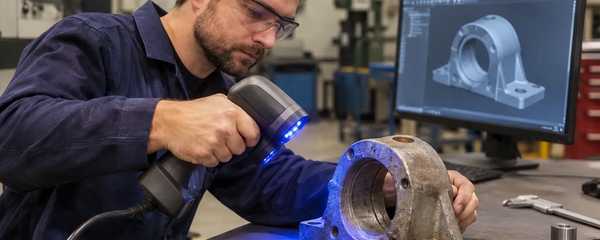
A typical project has five stages. First, the provider measures the part. It may use calipers, a coordinate measuring machine (CMM), a 3D scanner, or industrial CT for hidden internal features. Next, it processes the data into a usable point cloud or mesh. Then it rebuilds the geometry as a CAD model. After that, it works out which features reflect wear and which reflect the intended design. Finally, it validates the model against the measurement data and the agreed requirements.
The last two stages carry most of the engineering risk, and they are where providers differ most. If you want to see the full process for a part with no surviving documentation, our guide to obsolete parts reverse engineering walks through it step by step.
One scope note: "reverse engineering" also describes software and firmware analysis. This article covers physical, mechanical parts. If you are searching for a provider to decode code or a circuit board, the evaluation criteria are different.
Five Types of Reverse Engineering Companies and Which One Fits Your Part
Not every provider that offers reverse engineering does the same job. Most fall into one of five groups, and each suits a different kind of part.
| Provider type | Core strength | Watch out for | Best fit |
|---|---|---|---|
| 3D scanning bureau | Fast, accurate data capture with a range of scanners | May deliver a mesh, or subcontract the CAD modeling | Inspection, visualization, direct 3D printing |
| Metrology or inspection lab | High-precision measurement and inspection reports | CAD reconstruction and design intent may be a secondary service | Tight-tolerance features, first article inspection |
| Machine shop or contract manufacturer | Can measure and make the replacement in one place | Model may be built for their machines, not shared in editable form | One-off replacements you want made immediately |
| Freelance scan to CAD provider | Low cost for simple, well-defined modeling | Variable quality, limited validation, weak confidentiality controls | Non-critical parts with existing scan data |
| Engineering services firm | Design intent recovery, GD&T drawings, redesign and analysis | Usually needs the part shipped or scanned locally first | Functional parts, worn samples, assemblies, parts that keep failing |
For parts that must fit, seal or carry load, pick a 3D scanning and reverse engineering partner that also has mechanical engineers. For a cover you plan to print once, a scanning bureau is often enough.
The practical move is to decide which group you need before you request quotes. Comparing a scanning bureau's price with an engineering firm's price is comparing two different deliverables.
How to Evaluate a Reverse Engineering Service Provider
Eight checks reveal most of the difference between providers. Ask about each one directly, and ask for evidence rather than assurances.
Capture methods matched to the part
A capable provider explains which method it will use for each feature and why. Calipers and CMM probes suit bores, bolt patterns and datum faces you can reach. Structured light or laser scanning suits many freeform and cast surfaces. Industrial CT can show internal passages and cavities without cutting the part open. Depending on the part, radiography, ultrasonic testing or borescope inspection may also help.
A provider with one scanner tends to push every part through it. Ask: "Which features will you measure with what, and what accuracy do you expect on each?"
Design intent recovery from worn parts
A part that has run for ten years may no longer match its original design. Bores can wear oval, faces can corrode and edges can chip. A good engineer works out whether each one is wear, a quirk of manufacture or part of the design.
That call should rest on evidence: mating parts, unworn surfaces, standard sizes, old drawings and how the part works. A worn bore may need to be modeled as a true circle, but its target diameter still needs evidence behind it. Where the original design is uncertain, the provider should document the doubt and review it with you before anything is made.
Test this before you sign. Show the provider a worn feature and ask how they would tell service damage from intended geometry. A vague answer may mean you will receive a precise copy of the damage.
Material identification and surface condition
Geometry alone does not make a working replacement. Material grade, hardness, heat treatment, coatings and surface finish all change how the new part performs.
Ask whether the provider can identify these properties or arrange testing through a qualified laboratory. Confirm which tests are in scope, which need a specialist lab, and whether the results will be documented with the CAD files.
Native CAD files you can actually edit
Ask for a neutral STEP file plus native files in your own platform and version, with a clean feature tree. A "dumb" solid with no feature history is hard to change later. Check that the provider models in your software, not in another tool with a conversion at the end. Conversion can lose features. If you still have trustworthy drawings, CAD conversion and migration may get you to a 3D model faster than scanning.
Validation you can see
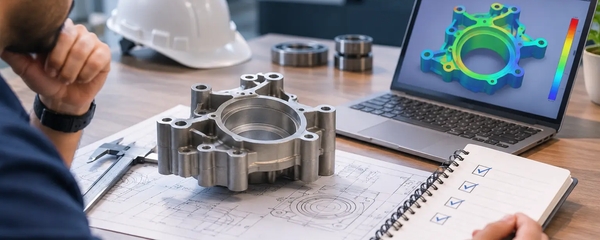
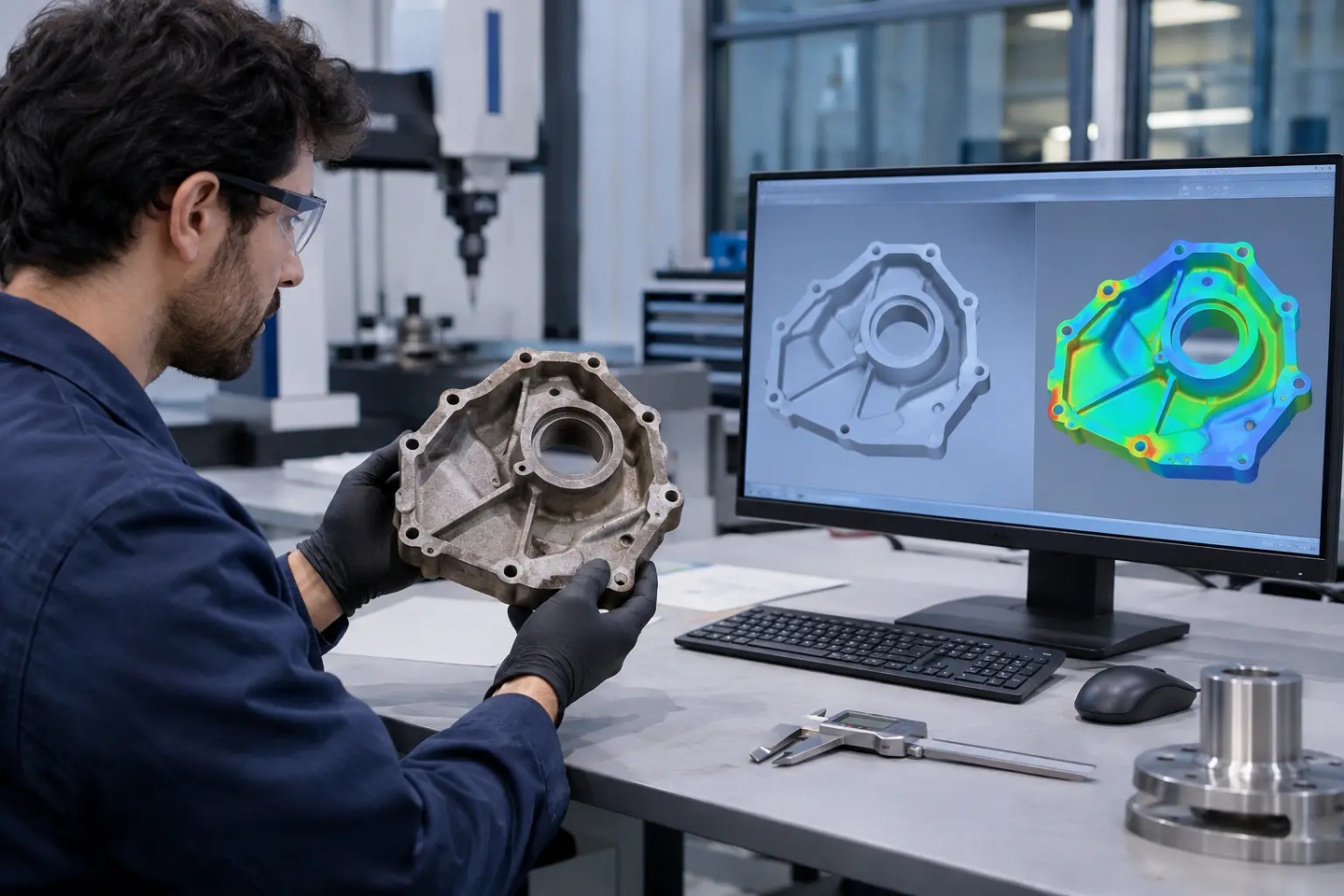
The key validation document is the deviation report. It usually includes a color map comparing the CAD model with the scan data, plus measured values for key features. It shows where the rebuilt geometry differs from the measured part.
A report you can trust states how the model was aligned, which datums were used, and the measured values against agreed tolerances. Keep one limit in mind: a close match between the model and the scan does not prove the scan itself was accurate. For critical dimensions, independent checks with calibrated measuring equipment may be needed.
Ask for an anonymized sample report and agree the acceptance criteria in the quote. Without stated tolerances and a clear measurement basis, "accurate" has no defined meaning.
Drawings and GD&T capability
If a supplier will quote or inspect the new part, you need 2D drawings with tolerances, datums and surface finish callouts. Not every scanning shop can make GD&T drawings good enough for production. Ask to see an anonymized example.
Logistics: ship the part or scan on site
Small and medium parts are usually shipped to the provider. Large or installed equipment needs on-site scanning. Many buyers combine the two: a local team captures the data, and a remote engineering team does the modeling. Ask how the provider handles shipping, insurance and the return of your part. Also ask if it can model from scan data you already have.
Support after the CAD model
The model is rarely the finish line. Ask whether the provider can produce a test-fit prototype through R&D and rapid prototyping, and whether it can strengthen a part that keeps failing. Copying a weak design repeats the failure. Analysis through computer aided engineering (CAE) can confirm a redesign before anything is machined.
What a Reverse Engineering NDA Should Cover
Sign a non-disclosure agreement before you send photos, drawings or samples. A reverse engineering NDA is different from a standard one. The provider handles your physical part and creates new data from it.
Check that your NDA covers:
- Physical samples as well as documents. The part itself, photos and any surviving drawings should count as confidential information.
- Derived data. Scan files, point clouds, meshes, CAD models and drawings the provider creates should be confidential too.
- Ownership of deliverables. State that you own all files produced for your project, and that ownership transfers on delivery or payment.
- Use restrictions. The provider should not reuse your geometry, show it in a portfolio or sell parts made from it.
- Subcontractors. Require written approval before any work is passed to a third party, with the same obligations applied.
- Data handling and deletion. Ask where data is stored, who can access it, and how it is returned or deleted when the project ends.
- Return of the part. Agree how and when the physical sample comes back, and in what condition.
An NDA protects your data. It does not decide whether you have the right to reproduce a part. Patents, design rights and supply contracts can still apply to a part you no longer buy. Check those with legal counsel before you make copies.
Run a Pilot Part Before You Commit
The lowest-risk way to choose between two providers is a paid pilot on one representative part. It shows you their real output, communication and validation before you commit a whole machine's worth of parts. Timing depends on the part, the scope, the provider's workload and shipping. Agree a realistic schedule before work starts.
- Pick a part that reflects your typical work, ideally one with at least one worn or critical feature.
- Mark the critical features and state the acceptance tolerance for each.
- Specify the deliverable: native CAD in your platform, STEP, drawing and deviation report.
- Open the model in your own CAD system and try editing two or three features.
- Have someone who did not order the work review the drawing as a supplier would.
- Compare the deviation report against your tolerances, then decide.
A pilot also tests the softer factors: how quickly the provider asks clarifying questions, and whether it flags problems instead of guessing.
Should You Outsource Reverse Engineering or Keep It In-House?
Outsource reverse engineering when the work is occasional, the parts vary a lot, or you lack design intent and drawing skills on staff. Bring it in-house when you have a steady flow of similar parts and someone to run the equipment full time.
| Factor | Outsourcing to a provider | Building in-house capability |
|---|---|---|
| Upfront investment | None beyond the project fee | Scanner, software licenses and training |
| Range of methods | Access to several capture technologies | Usually limited to the equipment you buy |
| Engineering judgment | Depends on choosing the right partner | Depends on hiring and retaining the skill |
| Volume fit | Occasional or varied work | Steady, repetitive work |
| Speed to first result | Fast once a provider is selected | Slower while the team ramps up |
Many companies outsource first. They learn which methods their parts need, then decide if owning equipment makes sense. Location matters too. Modeling hours usually make up most of a project, so an offshore engineering team can lower the total cost. The same total-cost thinking appears in our guide to product engineering outsourcing cost.
Questions to Ask a Reverse Engineering Company Before You Sign
These questions surface most risks during evaluation rather than at installation:
- Which measurement method will you use for each critical feature, and what accuracy do you expect?
- How will you separate wear from design intent on this part?
- Can you identify the material, hardness, heat treatment or coating, or arrange suitable testing?
- Do you model natively in our CAD platform and version, and will we receive the feature tree?
- Is a deviation report included, and can we see an anonymized example?
- Who does the CAD modeling: your own engineers or a subcontractor?
- Can you produce drawings with GD&T that our suppliers can quote from?
- Will you sign our NDA, and who owns the files at the end of the project?
- How many revision rounds are included, and what happens if mating parts arrive late?
If you want to understand how these answers affect price, see how much reverse engineering costs and the factors behind every part-to-CAD quote.
Red Flags When Comparing Reverse Engineering Providers
A few warning signs appear again and again:
- A firm price with no questions. A provider that quotes without asking what the part does or what it mates with is guessing.
- "We scan everything to 0.01 mm." Accuracy depends on the method, the part and the feature. A single number for every job is marketing.
- No sample deviation report. If a provider cannot show how it proves accuracy, it may not check.
- Mesh delivered as "CAD." An STL file is not an editable model. Confirm the format in writing.
- Reluctance to sign your NDA or vague answers about subcontractors and data storage.
- No engineer on the call. If only sales staff can discuss the part, design intent decisions may be made by whoever is available.
Reverse Engineering Provider Scorecard
Use this table to compare shortlisted providers on the same terms. It lists the evidence to request, not just the questions to ask.
| Criterion | Evidence to request | What good looks like |
|---|---|---|
| Capture methods | Proposed method per feature | More than one method, chosen per feature |
| Design intent | Their plan for a worn feature | Intended geometry supported by engineering evidence |
| Material | Testing capability or lab plan | Material grade and relevant properties documented |
| CAD delivery | Sample native file | Clean feature tree in your platform and version |
| Validation | Sample deviation report | Alignment, datums and values on critical features |
| Drawings | Anonymized drawing sample | Toleranced drawing with datums and GD&T |
| Confidentiality | Signed NDA, data policy | Clear ownership, no reuse, controlled subcontracting |
| Downstream support | Prototype and redesign options | Test-fit and analysis available when needed |
Choosing a Partner That Can Take a Part From Scan to Production
The right reverse engineering service provider gives you output you can use without rework. That means an accurate model you can edit, drawings a supplier can quote from, and proof that the shape matches your part where it counts. Settle method, design intent, validation and confidentiality first. Then compare prices on the same deliverable.
Monarch Innovation captures parts with 3D scanning and measurement, then rebuilds them as CAD models for obsolete components, undocumented assemblies and legacy equipment. When a part needs improving rather than copying, the same engineering team can analyze, simulate and prototype the change. Confidentiality, data handling and file ownership are agreed in writing before work begins.
Evaluating a reverse engineering partner?
Send photos of your part, what it mates with and the features that matter most. Monarch Innovation's engineering team will review your requirements and discuss the right capture method, deliverables and scope for a single pilot part.
Discuss your reverse engineering project