
Harsh Joshi
Co-founder & Technical Director
Part-to-CAD pricing swings widely. See published reverse engineering price ranges, the eight factors behind every quote, the hidden costs to check and how to brief a provider for an accurate estimate.
Reverse engineering cost depends more on how much engineering judgment a part needs than on how long it takes to scan. Published US price guides put a simple part-to-CAD job at roughly $800 to $3,000. A complex freeform part can run $3,000 to $15,000 or more. The single biggest swing factor is the deliverable: a raw scan mesh costs a fraction of a fully parametric CAD model with toleranced drawings.
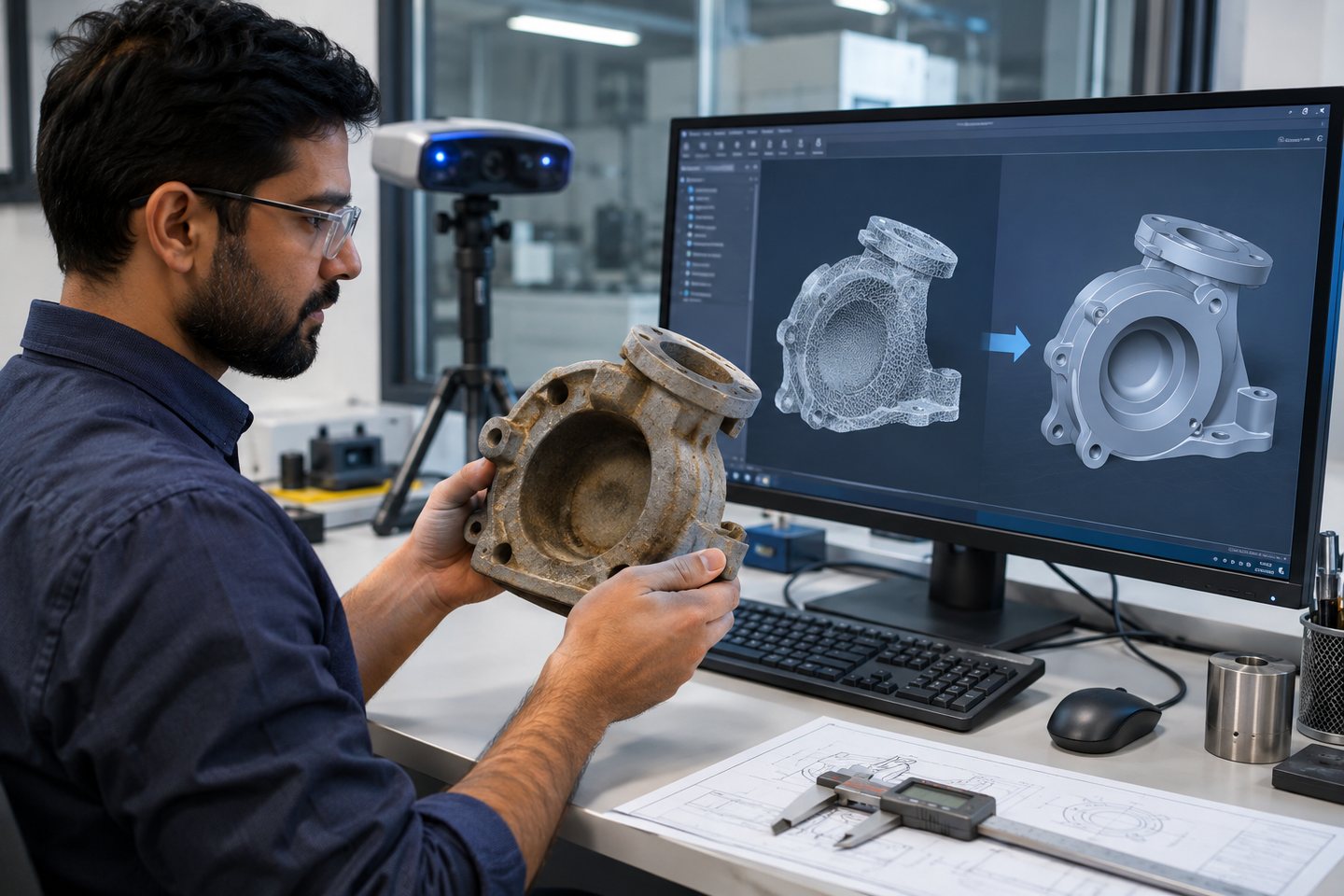
That range is wide because "reverse engineering" covers very different jobs. Recreating a machined bracket from caliper measurements is a few hours of modeling. Rebuilding a worn cast pump housing so a new one bolts straight into the old machine is a real engineering project. This guide shows where the money goes, what moves a quote up or down, which costs often sit outside it, and how to get an accurate estimate. It is written for maintenance, manufacturing and engineering leaders who need reverse engineering services for obsolete, undocumented or legacy components.
Five things drive reverse engineering cost: part complexity, required accuracy, sample condition, the deliverable you need and the number of mating parts. Modeling, not scanning, is usually the largest share of the bill.
Reverse Engineering Cost at a Glance
Price guides published by US providers in 2025 and 2026 give useful planning ranges. They are not quotes, and offshore delivery or unusual requirements can move a project outside them.
| Job type | Published planning range (US) | What usually drives the difference |
|---|---|---|
| 3D scan to cleaned mesh (STL) | Around $500 minimum, then $100 to $300 per scanning hour | Part size, surface finish, mesh cleanup |
| Simple part to parametric CAD | About $800 to $3,000 per part | Number of features, drawing requirements |
| Complex or freeform part to parametric CAD | About $3,000 to $15,000 or more | Freeform surfacing, tolerances, wear |
| Full package: scan, CAD and 2D drawing set | From about $3,000 for simple parts to the low five figures for complex ones | Depth of GD&T and documentation |
| Internal geometry by CT scanning | About $600 to $900 per part for simple parts, more for dense parts | Material density, CAD reconstruction scope |
Sources for these ranges are listed at the end of the article. Monarch Innovation does not publish a price list, because two parts that look similar in a photo can differ several times over in modeling effort.
What You Are Actually Paying for in Part-to-CAD Work
A part-to-CAD quote pays for engineering hours across five stages. Data capture is usually the smallest of them. One specialist provider estimates that every hour of scanning can require around two additional hours of scan cleanup and assembly before the data reaches CAD reconstruction. CAD modeling then adds further engineering time, depending on the part's complexity and the required deliverable.
- Data capture. Calipers for simple parts, a coordinate measuring machine (CMM) for precise features, and laser or structured light scanning for complex shapes. Industrial CT is used when internal passages cannot be reached any other way.
- Mesh processing. Aligning scans, removing noise and filling gaps to produce a clean point cloud or STL mesh.
- CAD reconstruction. Rebuilding the part as surfaces or as a feature-based solid in SolidWorks, Inventor, Creo, NX or the customer's preferred platform.
- Design intent recovery. Deciding what the original designer meant: true circles instead of slightly oval worn bores, standard hole and thread sizes, square faces and nominal wall thickness.
- Documentation and validation. 2D drawings with tolerances and GD&T, a deviation check of the CAD model against the scan, and sometimes a test-fit prototype.
Stages three and four are where most of the cost usually sits. They need an engineer who understands how the part works in its assembly, not just someone who can operate a scanner.
The Deliverable Decides Most of the Price
The file you ask for has more effect on reverse engineering cost than almost anything else. Each step up the ladder below adds engineering time, so the most cost-effective choice is the lowest level you will genuinely use.
| Deliverable | What you get | Best for | Relative cost |
|---|---|---|---|
| Point cloud or STL mesh | The measured shape as millions of points or triangles | Visualization, 3D printing a direct copy, inspection | Lowest |
| Surface model (NURBS) | Mathematical surfaces fitted over the mesh | Freeform shapes, styling surfaces, CFD studies | Medium |
| Solid model (STEP) | A closed, accurate solid with no editable feature history | Machining or sharing across CAD platforms | Medium to high |
| Native parametric model | An editable feature tree with design intent restored | Future changes, design variants, manufacturing updates | High |
| Parametric model plus 2D drawings with GD&T | Model, toleranced drawings and inspection references | Supplier quoting, production, quality control | Highest |
A common mistake is paying for a full parametric model and drawing set when the plan is to 3D print three spare parts. The opposite mistake costs more: buying a mesh, then discovering a machine shop cannot quote from it.
Eight Factors That Drive Reverse Engineering Cost
Geometry complexity
Prismatic parts made of flat faces, holes and pockets are quick to model. Cast, molded or sculpted parts with freeform surfaces must be surfaced patch by patch, which is slower and more manual. Freeform surfacing is widely treated as the largest single driver of reverse engineering cost.
Size and access to features
Large parts need more scan positions and alignment work. Deep pockets and internal cavities may be invisible to optical scanners. Reaching them can mean using a CMM probe, adding a CT scan or cutting open a spare sample.
Required accuracy and tolerances
A cosmetic cover can tolerate small deviations. A bearing seat, a sealing face or a gear mesh cannot. Tighter tolerances demand more precise capture equipment, more scan overlap and more careful checking, so each critical dimension adds time.
Condition of the sample
A part that has run for years is no longer the part that was manufactured. Bores wear oversize, edges chip and faces corrode. Separating wear from design takes engineering judgment, which is covered in more detail below.
Surface finish and material
Shiny, transparent or very dark surfaces scatter scanner light and often need a temporary coating, which adds preparation and cleanup. If the material is unknown, identifying it through hardness testing or lab analysis is a separate cost.
Number of parts and mating fit
One bracket is one job. A gearbox with a cover, a shaft and two bearing housings is several jobs plus an assembly check. Every mating face has to agree with its neighbor.
Documentation depth
An outline drawing with overall dimensions is quick. A multi-sheet drawing set with full GD&T, datum schemes, surface finish notes and material callouts can take as long as the modeling itself.
Target manufacturing process
The way the new part will be made shapes the model. A part headed for 3D printing needs less preparation than one headed for CNC machining. A part headed for an injection mold also needs draft angles, uniform walls and a defined parting line. One provider's published pricing roughly doubles from parts destined for 3D printing to parts destined for molding or machining.
As-Built or Design Intent? The Choice That Changes the Quote
An as-built model copies the part exactly as it measures today. A design-intent model recreates the part as it was meant to be made. The second costs more, and for most functional parts it is the only version worth paying for.
Consider a pump impeller housing that has run for a decade. A direct scan will capture an oval bore, eroded vanes and a slightly warped flange. Manufacture a replacement from that data and you reproduce the wear, along with every problem it causes. A design-intent model restores the bore to a true diameter, matches the bolt pattern to standard fasteners and returns the flange to flat.
As-built capture still has its place. It suits inspection, documenting a one-off fixture, or cases where the "error" is part of how the assembly now fits. The practical takeaway is to decide which you need before requesting quotes, because providers price the two very differently.
Costs That Usually Sit Outside the Quote
Many reverse engineering quotes cover capture and modeling only. Ask whether these items are included, or budget for them separately:
- Material identification, such as hardness testing, spectrometry or polymer analysis when no specification exists.
- CT scanning for internal passages that optical scanners cannot reach.
- Revision rounds when nominal dimensions or mating parts arrive after modeling has started.
- A test-fit prototype, often produced through CNC machining services or 3D printing, to prove the part fits before committing to production.
- Shipping, insurance and return handling for heavy or high-value components.
- Design improvements. If a part keeps failing, strengthening it is new engineering work. Computer aided engineering (CAE) such as FEA can confirm a redesign before anything is made.
Raising these questions early is the simplest way to avoid a quote that looks low on paper and grows once work starts.
Reverse Engineering or Another Route to a Replacement Part?
Reverse engineering is not always the cheapest way to get a usable CAD model. The right route depends on what information already exists.
| Starting point | Usually the better route | Why |
|---|---|---|
| Paper drawings or old 2D CAD exist and are trustworthy | CAD conversion | Modeling from drawings is faster than measuring a physical part |
| A physical part only, no documentation | Reverse engineering | The part is the only source of truth |
| Drawings exist but do not match parts in the field | Reverse engineering with drawing comparison | Field changes were never documented |
| The part fails repeatedly | Reverse engineering plus redesign | Copying a weak design repeats the failure |
If usable drawings survive, CAD conversion and migration services can turn them into modern 3D models at lower cost. When an older machine has a whole family of undocumented parts, sustaining engineering and legacy support treats them as one program instead of a string of one-off jobs.
How Reverse Engineering Cost Changes Across Four Typical Parts
These scenarios show where common parts tend to fall within the published ranges above. They are illustrations of effort, not quotes.
- A machined steel bracket with good access. Caliper or CMM measurement, a parametric STEP model and a simple drawing. This sits at the low end, because the geometry is prismatic and every feature is visible.
- A worn cast pump housing with two mating flanges. Scanning, design intent recovery on the bores and bolt patterns, and a drawing with GD&T on the sealing faces. Expect the middle of the range or higher.
- An injection-molded enclosure with snap fits and ribs. Freeform surfacing, consistent wall thickness and draft for tooling. Mold-ready geometry pushes this toward the upper range.
- An obsolete multi-part assembly. Each part is priced on its own merits, then an assembly fit check is added. This is usually the most expensive case, and also where a per-part quote can mislead.
How to Lower Reverse Engineering Cost Without Losing Accuracy
Most savings come from defining the job clearly, not from choosing the cheapest bid.
- Choose the lowest deliverable you will actually use. Do not buy GD&T drawings for a part you plan to 3D print once.
- Mark the critical features. Identify the fits, sealing faces and mounting points that matter, so tight tolerances are applied only where they are needed.
- Send the best sample you have. An unused spare is worth far more than a failed part from the machine.
- Include mating parts or their dimensions. This prevents a model that measures correctly but does not fit.
- Share any surviving data. Old drawings, catalog dimensions and known nominal sizes shorten design intent recovery.
- Batch similar parts. Grouping parts from the same machine spreads setup, shipping and project management across the order.
- Agree revision limits up front. A defined number of review rounds keeps scope from drifting.
What to Send for an Accurate Reverse Engineering Quote
A provider can only price what it can see. The more of this list you include, the closer the estimate will be to the final invoice.
- Clear photos from several angles, with a ruler or scale reference
- Overall dimensions, weight and material, if known
- The part's function and what it mates with
- Critical features and the tolerances they need
- Condition of the sample: new spare, used or failed
- Required deliverable: mesh, STEP, native CAD (with platform and version) or drawings
- Target manufacturing process and expected quantity
- Any existing drawings, catalog pages or past purchase specifications
- Required turnaround and any confidentiality (NDA) requirements
How to Compare Reverse Engineering Quotes
Compare quotes on the same deliverable, not on hourly rate. A low scanning rate can still produce a higher total if modeling, validation and drawings are billed separately.
Ask each provider to break the quote into capture, processing, modeling, drawings and validation. Then check who does the modeling. A shop that scans well but subcontracts CAD work may struggle with design intent on a functional part.
Delivery location matters too. Offshore engineering teams, including established hubs in India, can lower the cost of the modeling hours that dominate most part-to-CAD jobs. The trade-off is logistics: the part has to be shipped, or scan data captured locally and sent across. The same total-cost thinking applies here as in our guide to product engineering outsourcing cost.
Finally, confirm who owns the resulting files and how your data is protected. A part you can no longer buy may still be covered by patents, design rights or supply contracts, so check any legal questions with counsel before reproducing it.
Planning a Reverse Engineering Budget That Holds Up
A realistic reverse engineering budget starts with three decisions. Which deliverable do you need? Which features must be accurate? Should the new part copy the old one or improve on it? Settle those, and quotes become easier to compare and less likely to grow mid-project.
Monarch Innovation captures physical parts with 3D scanning and measurement, then rebuilds them as accurate CAD models for obsolete components, undocumented assemblies and legacy equipment. Where an original design has weaknesses, the same engineering team can analyze and improve it with simulation, then support prototyping and production. If you have a part that needs to become a CAD model, contact Monarch Innovation with a few photos and its function to get a scoped estimate.
Request a Reverse Engineering Estimate
Have an obsolete, worn or undocumented part? Share photos, dimensions and what the part does, and Monarch Innovation's engineering team will scope the right deliverable and give you a clear estimate for your part-to-CAD project.
Discuss your reverse engineering projectFrequently Asked Questions