
Harsh Joshi
Co-founder & Technical Director
Manufacturers with limited capital cannot automate everything at once. Here is a practical framework for deciding which processes to automate first and where manual production still makes sense.
A plant manager with one automation budget for the year has to decide where it does the most good. The packaging line is running three shifts and still falling behind. The assembly cell keeps losing trained operators faster than replacements can be hired. The inspection station has let one too many defects reach a customer. Every one of these looks like a case for automation, and there is rarely enough capital to fix all three at once.
Industrial automation vs manual production is not really an all-or-nothing choice. It is a sequencing question, and the sequence matters more than the size of the automation budget. Manufacturers should usually automate first where a stable, repetitive process creates the highest combined cost from labor, downtime, rework, quality problems, or safety risk, not the process that looks most impressive once it is automated. This guide walks through what separates a strong automation candidate from a process that should stay manual for now, a practical framework for prioritizing investment, and where hybrid production lines outperform an all-automated or all-manual approach. Monarch Innovation's manufacturing and plant optimization services work through exactly this kind of prioritization before any equipment gets specified.
Industrial Automation vs. Manual Production: What's the Difference?
Industrial automation replaces repetitive manual tasks with robotics, PLCs, or software-controlled equipment that performs the work with less variation and less ongoing labor. Manual production keeps people doing the work directly, using tools, fixtures, and judgment instead of programmed equipment. Neither approach is inherently better. Each one fits a different combination of volume, variability, and risk, and most plants end up running both at the same time on different stations.
The decision rarely comes down to cost alone. A manufacturer weighing automation against manual production should look at production volume, how often the process or product design changes, the consistency the task demands, and the safety or ergonomic risk involved. The table below summarizes which factors tend to favor each approach.
| Factor | Favors Manual Production | Favors Industrial Automation |
|---|---|---|
| Production volume | Low volume, small batches | High volume, sustained runs |
| Process stability | Design or steps change often | Process is stable and repeatable |
| Task variability | High variation, judgment required | Consistent, well-defined steps |
| Capital availability | Limited capital for equipment | Capital available and payback acceptable |
| Labor availability | Skilled labor available and affordable | Hard-to-fill or high-turnover role |
| Safety or ergonomic risk | Low operator risk | Repetitive strain, hazardous, or high-risk task |
| Quality consistency | Natural variation is acceptable | Tight tolerance or high consistency required |
None of these factors decides the outcome alone. A high-volume process with a stable design and a hard-to-staff role is a strong automation candidate on every count. A low-volume process that still changes design every quarter is a poor one, even if the labor cost looks high on paper.
Where Manual Production Still Makes the Stronger Case
Manual production remains the better choice whenever a process changes often, runs at low volume, or depends on judgment that is difficult to program. A few situations come up repeatedly.
- Low-volume or high-mix parts, where reprogramming and retooling cost more than the labor it would save
- Prototype and short-run work, where the design is still likely to change before it stabilizes
- Inspection or assembly steps that need dexterity or judgment, particularly for unusual or hard-to-define defects that a vision system was not trained to catch
- New products still moving through design iterations, before the process itself has settled into a fixed sequence
Automating any of these too early usually locks in a design that has not finished changing, which means paying for reprogramming later on top of the original investment.
Where Industrial Automation Pays Off First
Automation earns its investment fastest on high-volume, repetitive, well-defined tasks where consistency, throughput, or worker safety is the binding constraint. The strongest early candidates tend to share the same profile.
- Assembly cells running a stable product with predictable cycle times and few design changes on the horizon
- Packaging, palletizing, and material handling steps with consistent, repetitive motion and high daily volume
- Inspection tasks suited to machine vision, where the acceptance criteria are well defined and do not depend on subjective judgment
- Hazardous, physically demanding, or chronically understaffed operations, where the return is measured in safety and retention as much as throughput
A process that fits several of these traits at once, not just one, is usually the safest first bet for a limited automation budget.
The 6-Factor Framework for Deciding What to Automate First
Rather than starting with a technology, start with the constraint. Applied together, these six criteria usually surface the right first project.
- Identify the true bottleneck. Automate the step that limits total output or creates the most rework, not the step that happens to be easiest to automate.
- Check process stability. A process whose design or steps still change frequently should be stabilized before it is automated, not after.
- Measure volume and repeatability. Automation pays back fastest on high-volume, low-variation work. Low-volume or highly variable work rarely justifies the setup cost.
- Weigh safety and labor risk. A hazardous, ergonomically demanding, or chronically understaffed task can justify automation even with a longer payback period than a purely financial model would accept.
- Model the realistic payback. Include integration, programming, changeover, and training cost, not just the price of the equipment, when comparing options.
- Confirm the skill and capital are available. A team that cannot maintain or reprogram the equipment loses much of the expected benefit within the first year.
Labor availability deserves particular weight in that fourth criterion right now. In CADDi's 2026 American Manufacturing Survey, 79% of respondents named the skilled labor shortage as their biggest challenge heading into 2026. When a process depends on a role that is genuinely hard to staff, automation can reduce that exposure even when the payback period runs longer than a straightforward cost comparison would suggest.
Industrial Robot Adoption by Region
Investment decisions do not happen in isolation. Regional adoption trends give manufacturers a sense of how quickly competitors are moving, even though the right pace for any one plant still depends on its own bottlenecks rather than an industry average.
Robot density is rising across every major manufacturing region
Industrial robots per 10,000 manufacturing employees, 2024
| Western Europe | North America | Asia | Global average | |
|---|---|---|---|---|
| Robots per 10,000 employees | 267 | 204 | 131 | 132 |
Source: International Federation of Robotics, World Robotics 2025 report.
Robot density has grown across every major manufacturing region, and the gap between regions reflects different levels of industrial robot deployment. That trend does not mean every process should be automated. It means the business case for automation is easier to build for processes that already fit the criteria above.
Where Hybrid Production Lines Make Sense
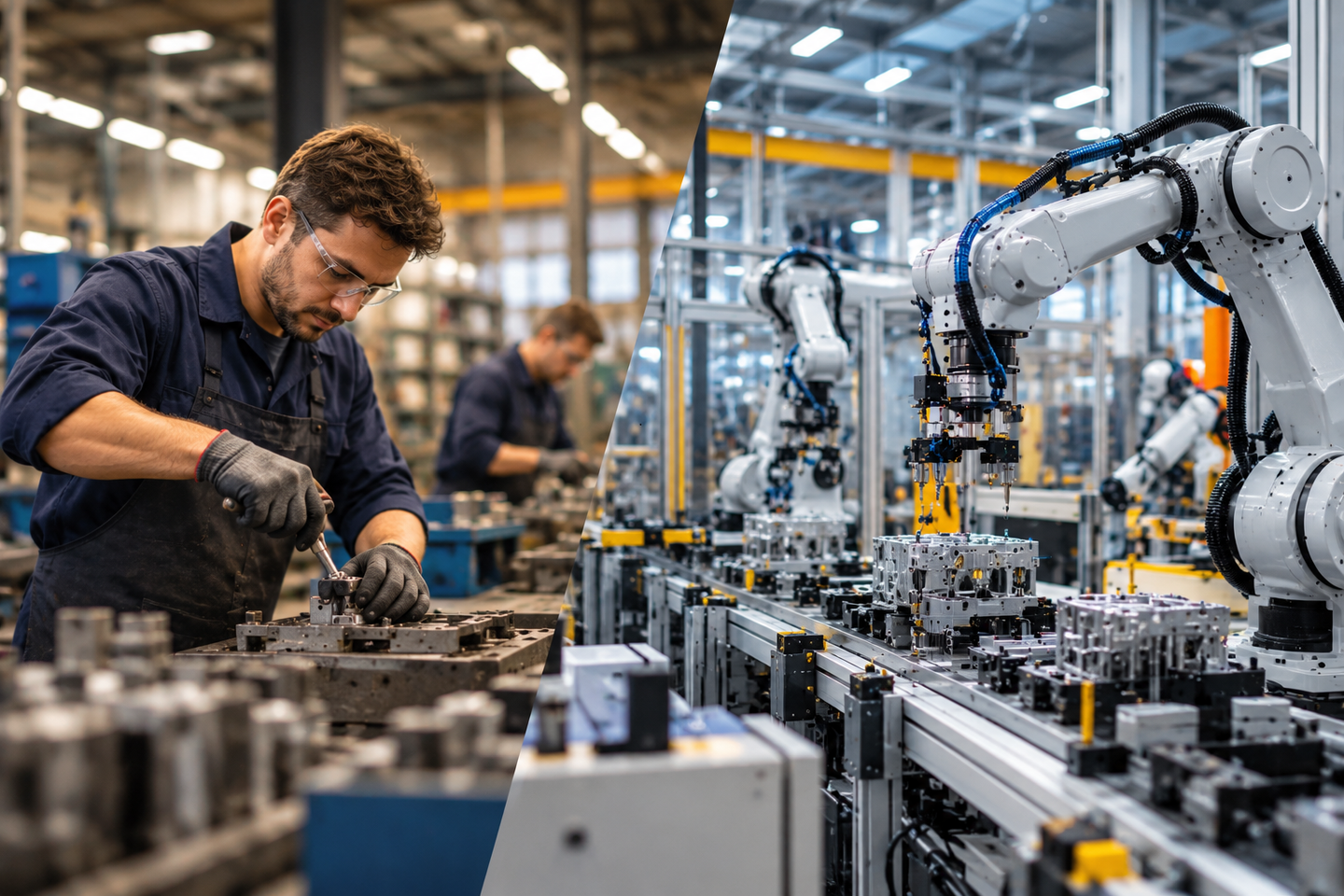
Most manufacturers do not choose between full automation and fully manual production. They build hybrid lines, where automated stations handle the repetitive, high-volume steps and manual stations handle small-batch variants, complex assembly, or final inspection. A packaging line, for example, might automate palletizing for its standard SKUs while keeping a manual station for specialty runs that come through too infrequently to justify reprogramming.
Deciding which stations on a shared line should be automated and which should stay manual is a line balancing question as much as an automation question. Monarch Innovation's production line balancing work analyzes station cycle times and work content to find where automation actually removes a bottleneck, rather than simply moving it further down the line.
Common Mistakes When Prioritizing Automation Investment
- Automating the easiest station instead of the actual bottleneck, which can produce a technically successful project without improving overall plant performance
- Skipping process and layout review, which can make an inefficient process run faster without actually fixing it
- Underestimating integration, changeover, programming, and training costs, turning an attractive payback calculation into a disappointing result
- Automating an unstable process too early, creating repeated reprogramming and retooling costs
- Ignoring labor availability and retention risk, which can understate the real value of automation
- Treating automation as a one-time decision rather than a sequence of investments that should change as volume, labor, and product requirements change
Building an Automation Investment Plan You Can Defend
The manufacturers who get the most from a limited automation budget treat industrial automation vs manual production as an ongoing sequencing decision, not a one-time bet. They start with the constraint that costs the business the most today, confirm the process is stable enough to automate, and revisit the plan as volume, labor availability, and product design change.
Once a process is confirmed as a strong automation candidate, planning the automation program itself is a separate engineering exercise, covering controls, data, and the operating model the equipment will run inside. Monarch Innovation works through this prioritization directly with manufacturing and plant teams, mapping bottlenecks, layout, and line balance before recommending where automation investment goes first.
Not Sure Which Process to Automate First?
Talk with Monarch Innovation's plant engineers about your current bottlenecks, volume, and labor constraints before committing capital to automation.
Schedule a Technical Call