
Choosing the right custom software development partner means evaluating more than pricing or technical skills. Look for a company with proven engineering expertise, transparent communication, a structured development process, strong security practices, clear IP ownership, and reliable post-launch support.
Before signing a contract, verify who will build your software, how they'll manage the project, and whether their process aligns with your business goals.
Never choose a software development partner based only on cost. Choose the one with the strongest engineering process, communication, and long-term support. The criteria below will tell you which is which.
We've built this checklist from what we look for internally at Monarch before we take on a project ourselves, and from the questions clients ask us most often during scoping calls.
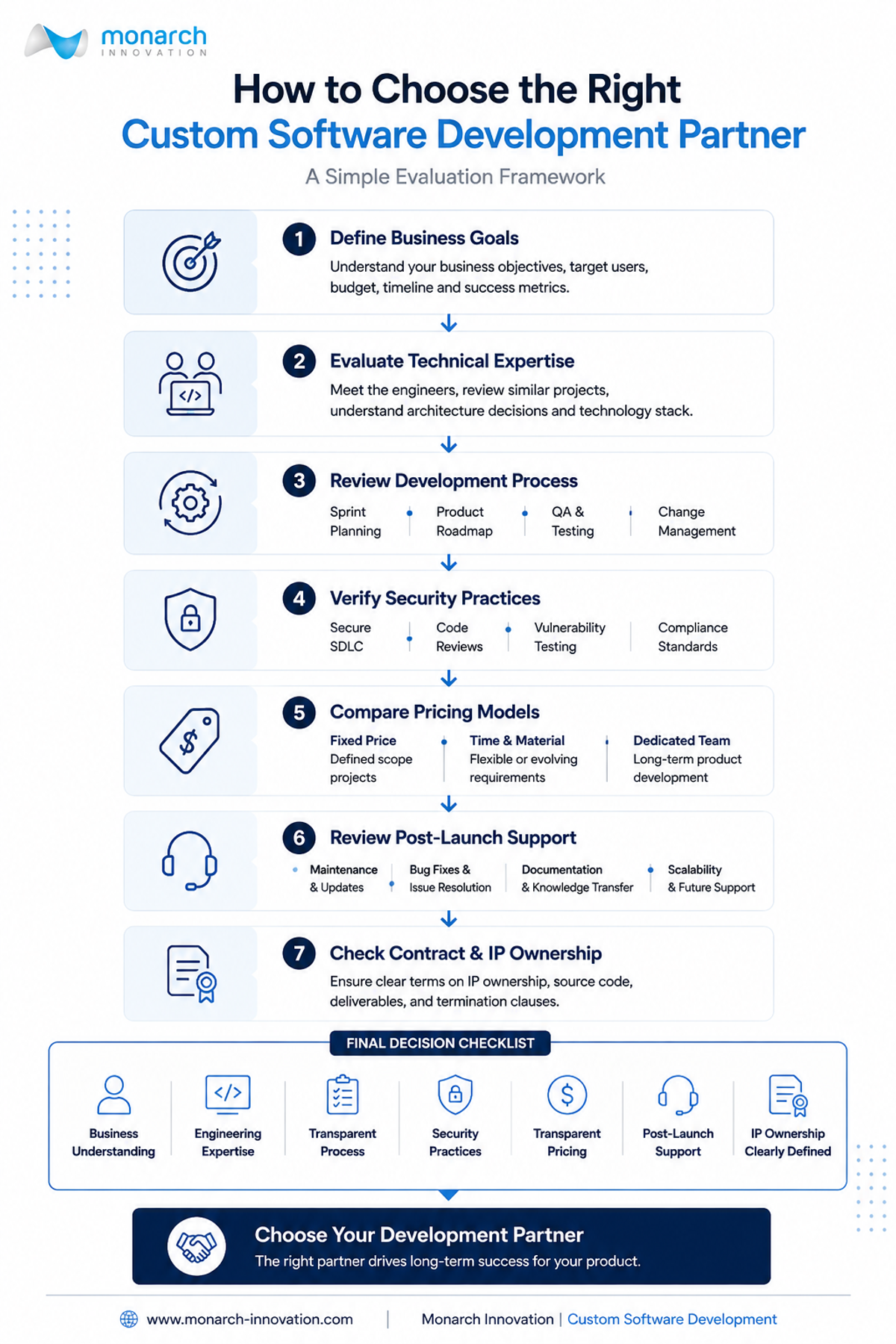
Quick Checklist Before Hiring a Software Development Company
Before signing a contract, confirm the company can answer YES to these questions.
- Do they understand my business goals?
- Can I meet the engineers working on my project?
- Do they follow a documented development process?
- Do they explain security and testing practices?
- Is source code ownership clearly defined?
- Do they provide post-launch support?
- Are project costs transparent?
If several answers are No, continue evaluating other vendors.
1. Verify Technical Expertise
A polished portfolio doesn't guarantee successful delivery.
Instead of asking "Have you built something similar?", ask:
- Can I speak with the engineers assigned to my project?
- Why did you choose this architecture?
- How do you ensure software quality?
- How do you review AI-generated code?
- What testing process do you follow?
What Good Partners Do
- Explain technical decisions clearly.
- Recommend technologies based on business goals.
- Discuss trade-offs instead of selling one solution.
- Demonstrate previous engineering experience.
Red Flags
- Only the sales team attends meetings.
- Technical questions receive vague answers.
- No documented QA process.
At Monarch, prospective clients speak directly with the engineers and architects who'll work on their project during scoping, not just an account manager, specifically so this kind of question gets a straight, technical answer before any contract is signed.
2. Review Their Development Process
Every company says they're Agile.
The important question is: how do they actually deliver projects?
Ask to see:
- Sprint planning process
- Product backlog
- Project roadmap
- Change request process
- QA workflow
Good development companies make progress visible throughout the project, not just at launch. This matters more than it sounds: industry research consistently finds that unclear requirements and uncontrolled scope creep, not weak technology choices, are among the leading causes of failed software projects. A visible, documented process is how a partner keeps requirements and scope under control as the project evolves.
3. Evaluate Communication
Poor communication causes more software project failures than poor coding. PMI's Pulse of the Profession research has repeatedly found that ineffective communication contributes to roughly one in three failed projects, making it one of the single biggest risk factors in any outsourced engagement.
Before signing, ask:
- Who is my main point of contact?
- How often will we meet?
- Which project management tools do you use?
- How are risks communicated?
- What happens if priorities change?
Good Sign: You know exactly who you'll work with before signing.
Red Flag: Communication goes through multiple account managers with limited technical knowledge.
4. Review Security Practices
Security shouldn't be an afterthought.
Ask:
- Do you follow a Secure SDLC?
- How is code reviewed?
- How do you perform vulnerability testing?
- How is customer data protected?
- Which compliance standards do you follow?
A Secure SDLC (a development lifecycle where security checks, such as threat modeling, code review, and vulnerability scanning, are built into every phase rather than bolted on before release) is documented in detail by OWASP and is a reasonable baseline to expect from any partner building software that touches customer data. Monarch Innovation's own engagements run on this model, backed by ISO/IEC 27001:2022-certified information security practices. Companies building enterprise software should be able to answer these questions confidently and specifically, not with a general "we take security seriously."
5. Compare Pricing Models
Don't compare only the total cost. Compare what's included.
- Fixed Price — best for clearly defined projects
- Time & Material — best for evolving requirements
- Dedicated Team — best for long-term development
The cheapest proposal often becomes the most expensive if scope changes aren't managed properly. This is exactly where unclear requirements and scope creep, two of the most commonly cited causes of project overruns, tend to surface first.
6. Understand Post-Launch Support
Software isn't finished after deployment.
Ask:
- What's included after launch?
- How quickly are bugs fixed?
- Is maintenance separate?
- Who owns documentation?
- Can another team maintain the software later?
Long-term support is just as important as development. A partner who can't clearly answer "can another team maintain this later" is signaling that your codebase may not be as portable or as well documented as it should be.
Common Mistakes Companies Make
Avoid these common mistakes when selecting a software development partner.
- Choosing the cheapest proposal
- Comparing portfolios only
- Never meeting the engineering team
- Ignoring security
- Assuming source code ownership
- Focusing only on launch, not maintenance
Final Vendor Evaluation Checklist
Before signing, make sure the company:
- Understands your business
- Has relevant technical experience
- Explains their delivery process
- Uses secure development practices
- Provides transparent pricing
- Offers post-launch support
- Clearly defines IP ownership
If every box is checked, you're far more likely to build a successful long-term partnership.
Need Help Evaluating a Software Development Partner?
Choosing the right technology partner is one of the most important decisions in any software project.
If you're planning a custom software solution or comparing development companies, our engineers at Monarch Innovation can walk through your requirements, review technical approaches, and recommend the most suitable development strategy for your business, with no obligation to sign anything.
Talk to our software consultants and make your next technology investment with confidence.
Frequently Asked Questions
How do I evaluate a software development company?
Review their engineering expertise, communication process, security practices, pricing model, and post-launch support, not just their portfolio.
Should I choose the cheapest software development company?
Not always. Lower pricing can indicate limited planning, fewer quality controls, or reduced long-term support.
What is the biggest red flag when choosing a software development partner?
A company that avoids technical discussions or refuses to introduce the engineers who'll work on your project.
Which pricing model is best for custom software development?
Fixed price works best for small, clearly scoped projects. Time and material suits flexible or evolving scope. A dedicated team model fits long-term products and ongoing development.