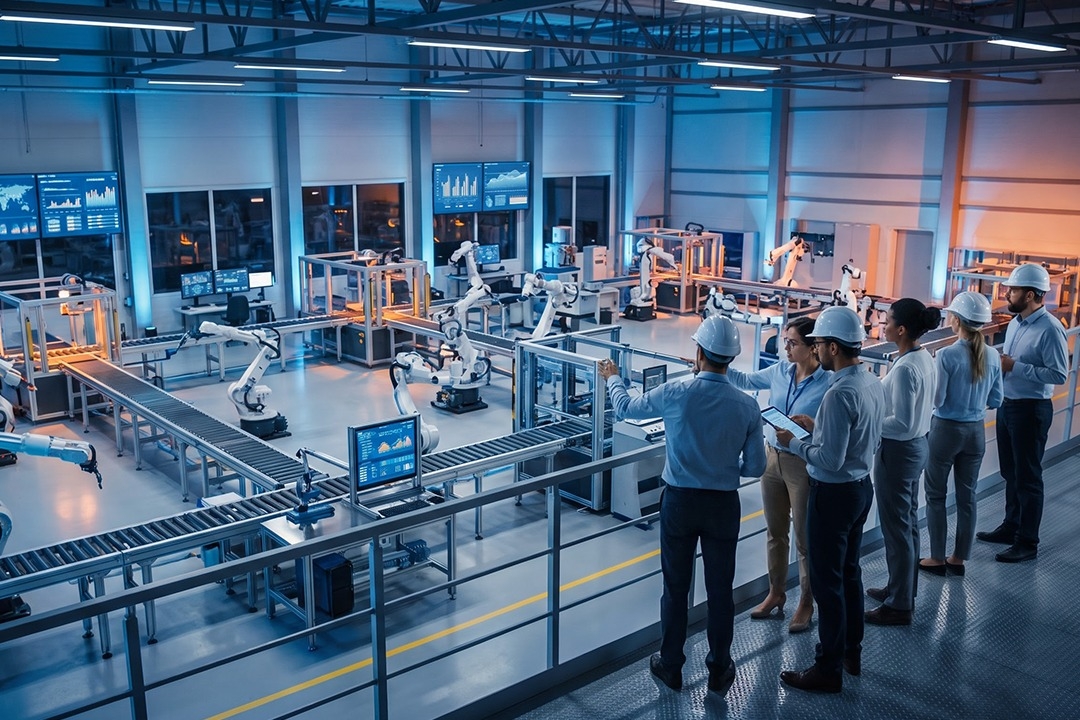

A typical plant manager may spend months evaluating PLCs, SCADA vendors, and integrators, only to discover six months into the project that none of them can connect shop floor data to the systems the business actually runs on. The automation works. The factory still isn't smart.
That gap between automating equipment and building a genuinely connected, data-driven factory is exactly where most vendor selection processes go wrong. Choosing an industrial automation company for a smart factory initiative isn't just about picking someone who can wire a PLC or configure a SCADA screen. It's about finding a partner who understands how operational technology, software systems, and business data need to work together.
In short: the right industrial automation company combines controls engineering with IT/OT integration, software and data engineering, cybersecurity, industry-specific experience, open standards, and long-term support. Before choosing a vendor, review relevant projects, ask detailed technical questions, run a small proof of concept, and check references from similar manufacturing environments.
The rest of this guide walks through how to evaluate that combination in practice, the questions worth asking before you sign anything, and the mistakes that turn a promising automation project into an expensive one.
What "Industrial Automation" Really Means in a Smart Factory Context
Industrial automation traditionally referred to control systems, PLCs, and SCADA software that run individual machines or production lines with minimal human intervention. A smart factory extends that idea considerably further.
In a smart factory, automation systems don't just control equipment. They generate continuous data streams that feed into analytics platforms, predictive maintenance models, digital twins, and enterprise systems like ERP and MES. The value isn't only in the automated process itself. It's in what the business can see and decide because of the data that process produces.
This distinction matters when you're choosing a partner. Many industrial automation companies are strong on the control side: PLC programming, robotics integration, motion control. Fewer are equally strong on the software side: data pipelines, cloud infrastructure, custom applications, IT/OT integration. Others come from a software background and understand data architecture well but lack hands-on plant floor experience.
The right partner needs to be credible on both sides. If one company can't cover both, you need two partners who can work together without friction.
Why the Wrong Automation Partner Is a Costly Mistake
Automation and control systems tend to stay in place for a decade or longer. A PLC program written in 2026 will likely still be running in a plant in 2036. A poor partner choice doesn't stay contained to a single project. It compounds over time.
Common consequences of choosing the wrong company include:
- Undocumented code and configurations that only the original engineer understands, creating a single point of failure when that person leaves.
- Automation systems that work in isolation but can't feed data into MES, ERP, or analytics platforms without expensive custom middleware.
- Vendor lock-in through proprietary protocols or closed hardware ecosystems that make future expansion or vendor switching difficult.
- Underestimated support needs once the system moves from a pilot to full production, leaving operations teams without a real escalation path.
None of these problems show up during a sales pitch or a proof of concept. They surface months or years later, usually during an expansion, an audit, or an unplanned outage.
Key Factors to Evaluate Before Selecting an Industrial Automation Company
IT and OT Integration Capability
Modern smart factories depend on operational technology (the PLCs, sensors, and control systems on the floor) talking to information technology (the servers, cloud platforms, and business applications running the company). A partner who only understands one side will eventually hit a wall.
Ask how the company approaches IT/OT convergence in practice. Do they have engineers who can design a data pipeline from a PLC through an edge gateway into a cloud platform? Or do they hand that work off to a third party they've never worked with before?
Software and Data Engineering Depth
Sensors and control systems only create value once the data they generate is captured, structured, and made usable. A company that treats data collection as an afterthought will leave you with a factory full of connected equipment and no meaningful visibility into performance.
Look for experience with custom software development, cloud infrastructure, and data platforms, not just automation hardware. Traditional automation integrators often fall short here compared with firms that combine industrial engineering with modern software development practices.
Industry and Application Experience
A company that has automated packaging lines may not have relevant experience with continuous process manufacturing, discrete assembly, or pharmaceutical production, where regulatory requirements and failure tolerances differ significantly. Ask for examples of work in your specific manufacturing environment, not just general automation experience.
The right questions depend on which environment you run:
For discrete manufacturing, ask about:
- PLC and HMI integration
- Robotic cell programming
- MES connectivity for production tracking
- OEE (overall equipment effectiveness) monitoring
For process manufacturing, ask about:
- SCADA and historian systems
- Process instrumentation and control loops
- Alarm management
- Batch data handling and traceability
Standards, Protocols, and Future Scalability
Smart factory systems should be built on open, well-supported standards such as OPC UA, MQTT, and common industrial Ethernet protocols rather than proprietary systems that lock you into one vendor's ecosystem. A partner who defaults to open standards is generally easier to expand, audit, and eventually hand off to another team if needed.
Cybersecurity Practices
Connecting operational technology to IT networks and cloud platforms increases the attack surface of a factory considerably. A credible automation partner should be able to explain how they segment networks, secure remote access, and handle firmware and software updates across the automation stack. Security shouldn't be a checkbox item in a proposal.
Support Model and Long-Term Availability
Ask what happens after go-live. Is there a documented support process, defined response times, and a team that will still exist in five years? Smaller firms and individual contractors may offer lower upfront costs. They also carry higher risk if key people leave or the company shuts down.
Documentation and Knowledge Transfer
Every deliverable, from PLC logic to system architecture diagrams, should be documented in a way that another engineer could pick up without needing the original team. Ask to see a documentation sample before signing a contract.
Automation Integrators vs. Digital Engineering Partners
Not every company that calls itself an "industrial automation company" offers the same thing. It helps to understand the general categories before comparing vendors.
| Partner Type | Strengths | Common Gaps | Best Suited For |
|---|---|---|---|
| Traditional automation integrator | PLC programming, robotics, panel design, hardware commissioning | Limited software, cloud, or data engineering capability | Straightforward equipment automation |
| Software and digital engineering firm | Custom applications, cloud infrastructure, data platforms, IoT integration | May lack deep plant floor or controls engineering experience | Data-driven digital transformation |
| Hybrid digital engineering and automation partner | Combines controls knowledge with software, cloud, and data expertise | Fewer companies genuinely operate at this intersection | Full smart factory initiatives |
Most smart factory initiatives benefit from the third category, or from a lead partner in one category with a proven track record of working closely with the other. If your project depends heavily on connecting shop floor data to business systems, digital twins, or predictive analytics, prioritize a partner with genuine experience across industrial automation and robotics engineering, not just control panel installation.
Questions to Ask Before Signing a Contract
Before committing to any industrial automation company, get clear answers to these questions:
- Can you walk us through a project where you connected shop floor automation to a cloud or enterprise data platform?
- How will you integrate our existing PLCs, SCADA, MES, and ERP systems?
- Which open standards and protocols do you default to, and why?
- What does your documentation package look like at project handover?
- Who owns the source code, configurations, documentation, and system credentials after handover?
- How do you handle cybersecurity for connected OT systems?
- What is your support and response model after go-live, and who owns escalations?
- Who specifically will work on our project, and what is their background?
- How do you handle scope changes once the project is underway?
If a vendor can't give you specific examples for these, treat that as a warning sign.
Red Flags to Watch For When Choosing an Automation Partner
A few warning signs tend to show up before problems ever reach the plant floor. Watch for a vendor who:
- Can't show similar projects in a comparable manufacturing environment.
- Relies on one engineer for the entire system, with no backup or team structure.
- Promises documentation only after commissioning, rather than throughout the project.
- Leans heavily on proprietary protocols instead of open standards.
- Can't clearly explain their cybersecurity approach for connected OT systems.
- Has no defined post-go-live support process or escalation path.
- Can't explain how PLC or SCADA data will actually reach MES, ERP, or cloud systems.
- Presents a proposal that's heavy on hardware but barely mentions data architecture.
Any one of these on its own isn't necessarily disqualifying. Several together are a strong signal to keep looking.
Common Mistakes to Avoid When Selecting an Automation Partner
Businesses evaluating automation partners tend to repeat a few avoidable mistakes. Choosing based on price alone is one of the most common. The lowest bid rarely accounts for long-term support, documentation quality, or the cost of fixing undocumented systems later.
Another frequent mistake is assuming that automation experience automatically includes software and data capability. A company can be excellent at PLC programming and still have no meaningful experience building the data pipelines or cloud infrastructure a smart factory needs.
Skipping reference checks is another common error. Talking to a company's past clients, particularly ones with a similar scale or industry, usually reveals more about reliability and communication style than any proposal document.
Finally, some businesses treat automation as a one-time project rather than an ongoing relationship. Smart factory systems need updates, monitoring, and periodic re-architecture as the business grows. A partner who disappears after go-live isn't set up to support that.
A Simple Vendor Scoring Framework
Comparing proposals side by side is easier with a weighted scorecard rather than a gut-feel decision. Score each vendor from 1 to 5 in each area, multiply by the weighting, and total the results.
| Evaluation Area | Suggested Weight |
|---|---|
| IT/OT integration capability | 20% |
| Relevant industry experience | 15% |
| Software and data engineering depth | 15% |
| Cybersecurity practices | 15% |
| Scalability and open standards | 10% |
| Documentation quality | 10% |
| Support and maintenance model | 10% |
| Cost | 5% |
Adjust the weights to match your own priorities. A pharmaceutical manufacturer, for instance, may weight cybersecurity and documentation higher due to regulatory requirements. What matters is comparing vendors against the same criteria rather than being swayed by whichever proposal reads best.
A Practical Framework for Shortlisting Vendors
- Define the outcome, not just the equipment. Decide what business decisions or efficiency gains the smart factory initiative needs to support before evaluating vendors.
- Shortlist based on relevant experience. Prioritize companies with documented experience in your industry and in connecting OT systems to software platforms.
- Score against the framework above. Use a weighted scorecard rather than relying on gut feeling.
- Run a small proof of concept. A limited pilot on one line or process reveals more about a partner's real capability than any proposal.
- Check references from similar projects. Ask past clients specifically about post-launch support and how issues were handled.
- Confirm the long-term relationship, not just the initial scope. Clarify what ongoing support, monitoring, and future expansion look like before signing.
Planning a Smart Factory Project?
A smart factory isn't built in a single project. It's built through a series of decisions about equipment, data, and software that either compound into a genuinely connected operation or create isolated systems that never quite talk to each other. The company you choose to handle industrial automation shapes which of those outcomes you get.
Monarch Innovation works at the intersection of industrial engineering and modern software development, helping manufacturers connect automation systems to the data platforms and applications that turn equipment activity into operational insight. Our embedded systems and IoT solutions cover machine monitoring, predictive maintenance, and smart factory systems built on industrial IoT protocols, backed by automation and robotics engineering and the digital engineering capability needed to turn that data into usable software and analytics.
Talk to the Monarch Innovation engineering team about your automation, IT/OT integration, IoT, and smart manufacturing requirements. Discuss your project with us directly.
Frequently Asked Questions
How do I choose the right industrial automation company for my factory?
Evaluate candidates on IT/OT integration experience, software and data engineering depth, relevant industry experience, use of open standards, cybersecurity practices, and their long-term support model. A small proof of concept and reference checks from similar projects will reveal more than a proposal document alone.
What's the difference between an automation integrator and a digital engineering partner?
A traditional automation integrator focuses on PLC programming, robotics, and panel design. A digital engineering partner adds custom software, cloud infrastructure, and data platform capability. Smart factory projects generally need both skill sets, whether from one hybrid partner or two that collaborate closely.
How much does industrial automation for a smart factory typically cost?
Costs vary widely based on the scope, from a single automated line to a full facility rollout involving IoT sensors, data platforms, and enterprise integration. Rather than comparing headline prices, evaluate proposals based on what's included for support, documentation, and future scalability.
Do I need a separate vendor for IoT and data platforms, or can one company handle everything?
Some companies handle both automation hardware and the software and data side, while others specialize in one area. A hybrid partner with proven experience across both reduces coordination overhead and the risk of gaps between systems that don't fully integrate.
What open standards should a smart factory automation system use?
Common choices include OPC UA for interoperability between industrial devices and software systems, MQTT for lightweight IoT messaging, and standard industrial Ethernet protocols. Systems built on open standards are generally easier to expand, audit, and maintain over time compared with proprietary alternatives.
How long does a typical smart factory automation project take?
Timelines depend heavily on scope. A single production line pilot might take a few months, while a full facility rollout involving multiple systems, IoT integration, and enterprise data connections can take a year or longer when phased properly.
What questions should I ask an automation vendor during the sales process?
Ask about their experience connecting shop floor systems to enterprise or cloud platforms, their approach to cybersecurity, their documentation standards, and their support model after go-live. Specific, detailed answers are a better signal than a polished sales presentation.
Is it risky to use a smaller automation company instead of a large vendor?
Smaller companies can offer more direct engineering access and flexibility, but it's worth confirming their team size, documentation practices, and business continuity plans. The bigger risk factor is usually undocumented, single-person-dependent systems rather than company size itself.